Zsuzsa Ferge
1931 - 2024
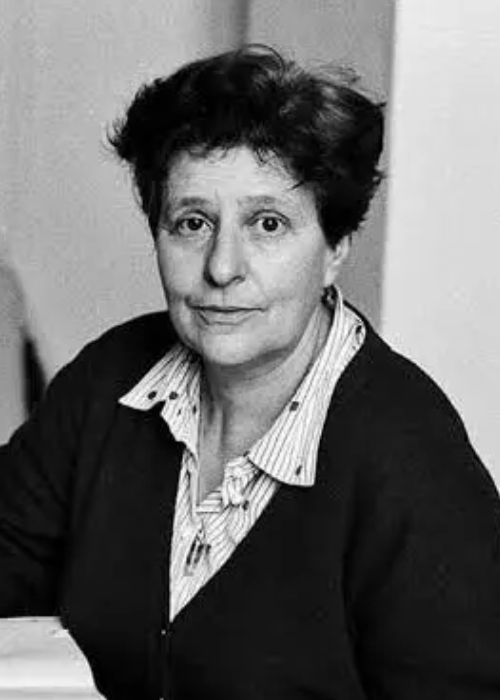
Photograph: Tamás Szigeti
“Ensuring equality between the sexes is now not only an accepted norm in socialist countries, but also an increasingly global demand, as demonstrated by the congresses and conferences organised to mark the {glossary:Year of Women}, among other things. There is also a certain convergence in the principles that can be employed to achieve this goal. Even in the non-socialist world, it is becoming increasingly clear that legal and political equality alone is not enough; without an economic foundation, it is more a formal than a true achievement.” (Zsuzsa Ferge, 1976)
“A nemek közötti egyenlőség biztosítása ma már nemcsak a szocialista országok elfogadott normája, hanem egyre inkább világméretű követelés, ahogyan ezt többek között a nők éve alkalmából rendezett kongresszusok és konferenciák bizonyították. Bizonyos közeledés mutatkozik azokban az elvekben is, amelyeknek segítségével e cél közelíthető. Egyre világosabbá válik a nem szocialista világban is, hogy a jogi-politikai egyenlőség önmagában kevés, gazdasági megalapozottság nélkül inkább formális, mint valóságos vívmány.” (Zsuzsa Ferge, 1976)
Biography
Ferge, Zsuzsa (25 April 1931, Budapest – 4 April 2024, Budapest), née Kecskeméti, was a Hungarian sociologist and statistician of international renown. She gained prominence for her analyses of social stratification and poverty under state socialism and during the post-transformation period. Beyond these well-known contributions, Ferge was also a persistent advocate for gender equality in socialist Hungary, working closely with the {glossary:National Council of Hungarian Women (MNOT)} and taking an active role in their initiatives.
Social background and private life
Ferge was born into a Jewish, intellectual middle-class family as one of three children of Ágota Keller and György Kecskeméti, a journalist and editor at the prestigious German-language newspaper Pester Lloyd. In 1944, during the persecution of Jews in Budapest, her mother went into hiding with the children in a friend’s apartment, while her father and grandparents perished in the Holocaust. After the end of the Second World War, Ferge’s mother, left without money or a place to stay, decided to send her children to France with a relief convoy for Jewish children. There, both older sisters attended a gymnasium in Versailles, where they became fluent in French. In early 1948, the children returned to Hungary, and after completing her secondary education, Ferge began studying economics at Karl Marx University in Budapest (1949–1953). It was during her university years that she met Sándor Ferge, whom she married in 1953. He came from a modest village near Debrecen in eastern Hungary and had been admitted to university through the socialist government’s social mobility programs. Because he was neither Jewish nor from an influential intellectual family, he faced certain prejudices, particularly from his mother-in-law. In 1953, Ferge gave birth to their son, and two years later to their daughter. Both children were cared for by an elderly lady who, despite being employed as a nanny, became part of the family and continued to help even after the children began attending state kindergarten.
Education and professional path
Already during her studies in economics at Karl Marx University in Budapest, Ferge worked at the Central Statistical Office, where she continued her professional career after receiving her degree. At her initiative, and with the support of what she later described as a “flexible, courageous, and modern management,” she became head of the newly established Department of Stratification Research in 1960. In 1969, she transferred to the newly founded Sociological Research Institute of the Hungarian Academy of Sciences, where she led the Department of Social Policy. Ferge earned her Ph.D. in sociology in 1982 with a dissertation on social reproduction and social policy. In 1988, she was appointed full professor at Eötvös Loránd University in Budapest and head of its Department of Social Policy, later receiving emerita status in 2001. Her research career, however, did not end there: from 2005 until her death, she continued to study social stratification and child poverty. Among her most important publications are The Stratification of Our Society (1969), The Social Determinants of the School System and School Knowledge (1976), Studies in Social Policy (1980), Chapters from the History of Hungarian Poverty Policy (1986), Escalating Inequalities (2000), and Social and Welfare Policy in Hungary, 1990–2015 (2017).
Research and activism with an emphasis on feminist knowledge
Ferge became particularly known for her pioneering research on social inequalities, stratification, poverty, and social policy. Central to her work were marginalized and excluded groups, as well as the situation of women and gender relations in state-socialist Hungary, especially from the 1960s to the 1980s. Building on her research as part of the {glossary:international study on time budgets} led by sociologist Sándor [Alexander] Szalai, she presented on the employment and time use of women at the World Congress of Sociology in Evian in 1966. Her analysis quantified the burden borne by mothers, showing that most had little to no time for leisure and often had to forgo an hour of sleep to meet their responsibilities. The final results of Ferge’s research were published in the collective volume Use of Time (1972) which presented the outcomes of the aforementioned study led by Szalai.
Another significant study, co-authored with trade unionist Júlia Turgonyi in 1969, examined 260 women factory workers across six factories. The findings highlighted persistent gender inequalities, including pay gaps between equally qualified men and women, unhealthy working conditions, exhaustion from three-shift schedules, and the uneven distribution of household labour.
In 1976, Ferge published Once Again on the Socio-Economic Basis of Gender Equality, critically evaluating Hungary’s three-year maternity leave program {glossary:GYES (gyermekgondozási segély)}. She regarded GYES as a positive social policy, while also recommending major reforms, including extending parental wage rights to fathers. She argued that “a mother’s wage accepts the traditional bias that a mother’s role is primarily child-rearing and housework,” and proposed that “with a consistent egalitarian approach, we should speak of ‘parents’ wages’ rather than ‘mothers’ wages’, allowing parents to decide whether the mother or father receives it.” Her policy advice aimed to address the ways GYES “legally sanctions the monopoly of women in domestic work” through financial incentives.
In another book chapter from 1983, titled “Is the Situation of Women Currently Changing?”, Ferge highlighted the ongoing challenges to gender equality, particularly in professional education, the gender pay gap, employment, and the division of labor between men and women in the home, childcare facilities, and GYES. She was a strong proponent of the idea that effective and innovative social policy design could transform traditional societal norms. The 1982 amendment to GYES, which opened the program to fathers, was the result of her sustained efforts in this direction. In this context, she emphasized the symbolic importance of such reforms in a society that continued to consider childcare primarily a woman’s responsibility, and that treated women as second-class workers who “take on jobs” rather than “go to work”.
Ferge’s commitment to gender equality extended beyond her academic work. She was actively involved with the {glossary:National Council of Hungarian Women (MNOT)}, and for a time during the 1970s also served as a member of the Presidium, contributing her sociological expertise to policy discussions and social research initiatives. Throughout her professional career, she was a fervent advocate for women’s emancipation, consistently pointing out the gap between the socialist party state’s ideological commitments to gender equality and the lived realities faced by women on the ground.
International engagement and networks
She was an internationally highly respected scholar, as reflected in her appointed leadership roles within the International Sociological Association (ISA). Among other roles, she served as a board member of the ISA Research Committee on Education (1971–1978) and as vice-president of the ISA Research Committee on Poverty, Social Welfare, and Social Policy (1990–1994). She maintained a lifelong friendship with Pierre Bourdieu, whom she first met in Paris in 1964. Ferge published extensively in Hungarian, with many of her works also appearing in English, and selected pieces translated into French, German, Polish, and Romanian. From the 1970s onward, she was frequently invited to universities abroad as a guest researcher and lecturer, particularly in the United Kingdom, the United States, and Austria. In 1997, the University of Edinburgh awarded her an honorary doctorate.
Legacy and Influence
Ferge was the author or co-author of more than three hundred academic publications. She has been a prominent publicist, publishing articles on social policy in several daily and weekly newspapers. During her lifetime, she was awarded highest honors for Hungarian academics, such as the Széchenyi-Prize. When Ferge died in April 2024, Dorottya Szikra, one of her closest disciples, remembered her as a person with a “good sense of humour, a great education and a very warm heart. She loved to take care of those around her, she was an extraordinary host to those who just dropped by, whether in her apartment in Budapest or in her house in Monoszló [close to Balaton].” Therefore, she was not only an influential academic but also mastered the art of networking, displaying a generosity of spirit characteristic of truly exceptional intellects.
Annina Gagyiova
Selected Works
Susan (Zsuzsa) Ferge, “Time-Budget Studies in the Statistical Work of Hungary,” in Statistical Social Surveys in Hungary. Stratification and Time-Budget-Studies (Prepared for the Sixth World Congress of Sociology in Evian 4th-11th September 1966), ed. Hungarian Central Statistical Office (Budapest, 1966), 27–48.
Júlia Turgonyi and Zsuzsa Ferge, Az ipari munkásnők munka- és életkörülményei (Budapest: Kossuth Könyv Kiadó, 1969).
Zsuzsa Ferge, “A társadalompolitika és a nők,” in Tanulmányok a nők helyzetéről, ed. Egon Szabady (Budapest: Kossuth Könyv Kiadó, 1972), 35-55.
Zsuzsa Ferge, “Még egyszer a nemek közötti egyenlőség társadalmi-gazdasági alapjáról,” in Nők – Gazdaság – Társadalom. Tanulmányok a nők helyzetéről II., ed. Magyar Nők Országos Tanácsa (Budapest: Kossuth Könyvkiadó, 1976), 47–69.
Zsuzsa Ferge, “The relation between paid and unpaid work of women: a source of ineuqality – with special reference to Hungary” Labour and Society 1/1-2 (1976), 37-52.
Zsuzsa Ferge, “Bringing in the Verdict on Women’s Rights” Szociológia 2 (1977), 202-219.
Zsuzsa Ferge, “Változik-e manapság a nők helyzete?,” in A női munkáról. Tanulmányok, ed. Magyar Nők Országos Tanácsa (Budapest: Kossuth Könyvkiadó, 1983), 230–57.
Zsuzsa Ferge, “Biológiai különbségek, társadalmi egyenlőtlenségek,” in A nők társadalmi szerepvállalásának biuológiai problémái, ed. György Csaba (Budapest: TIT, 1984), 101-114.
Zsuzsa Ferge, “Biologikum és nemek közötti egyenlőség,” in Nők és férfiak. Hiedelmek, tények, ed. Magyar Nők Országos Tanácsa (Budapest: Kossuth Könyvkiadó, 1985), 68–92.
Zsuzsa Ferge, “Kell-e Magyarországon a feminizmus?” Ifjúsági Szemle 7/2 (1987), 3-7.
John Keane, Júlia Szalai, Zsuzsa Ferge, “Social Policy and Socialism. Citizenship, the Working Class, Woman and Welfare – an East-West Dialogue” in Social Policy in the New Eastern Europe: What Future for Socialist Welfare?, ed. Bob Deacon and Júlia Szalai (Brookfield et al.: Aldershot, 1990), 27-48.
Zsuzsa Ferge, “Women and the transition in Central and Eastern Europe: the ‘old left’ and the ‘new right’. Paper prepared for the conference “Family, sexuality and labour markets: the role of symbolic politics in the assault on the welfare state”. University of Bergen, Norway, May 26-28, 1995.
Zsuzsa Ferge, “Women and Social Transformation in Central-Eastern Europe: The ‘Old Left’ and the ‘New Right,” Czech Sociological Review 5, no. 2 (1997): 159–78.
Bibliography
Erzsébet Takács, “‘In the Mantle of Professionalization.’ The Openness and Confinement of Family Sociology in Hungary during the 1970s and 1980s,” Múltunk (2019), 155–91.