Zofia Kuratowska
1931 - 1999
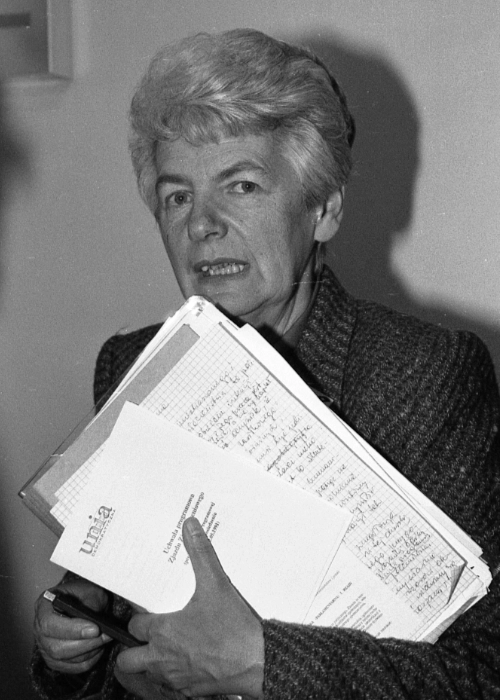
Zofia Kuratowska at the founding congress of the Freedom Union [Unia Wolności] in 1994. Sygnatura: OK_0906_0016_0008_031 23-24.04.1994, Warszawa, Polska. Zofia Kuratowska podczas kongresu założycielskiego Unii Wolności. Fot. Mieczysław Michalak, zbiory Ośrodka KARTA
“We talk a lot about protecting unborn lives, but perhaps, when we speak about the state, society and their responsibility, we should think about the responsibility to protect life in general. During the [abortion] debate I mentioned the problem of frequent spontaneous miscarriages and cases of premature births in the regions that are particularly affected by environmental pollution. In Silesia and in other places where the conditions of work are particularly detrimental for women’s health. […] This is a genocide conducted so to say by the state which does little to counteract the results of environmental pollution.”
„Tymczasem mówimy o ochronie życia nienarodzonych, ale chyba, jeżeli mówimy o obowiązkach państwa i obowiązkach społeczeństwa, to jest to obowiązek chronienia życia w ogóle. Poruszyłam w swojej wypowiedzi w czasie debaty sprawę tak częstych poronień samoistnych czy porodów niewczesnych w okolicach szczególnie dotkniętych zanieczyszczeniem środowiska. Taki Śląsk albo inne miejsca, gdzie warunki pracy również są bardzo szkodliwe dla zdrowia kobiet. […] To jest ludobójstwo, którego dokonuje niejako państwo, nie zapobiegając skutkom zanieczyszczenia środowiska.”
Quoted in ‘Wokół prawnej ochrony dziecka poczętego [Dyskusja z udziałem senatorów], Zofia Kuratowska’, Ethos (1991), 1-2, 181-185.
Biography
Zofia Kuratowska (20 July 1931, Skolimów, Poland – 8 June 1999, Pretoria, Republic of South Africa) was a medical doctor specialising in haematology and immunology. She was active in education and public health advocacy, particularly concerning patients living with HIV/AIDS both in Poland and internationally. In the 1980s she became an active member of Poland’s democratic opposition and participated in the 1989 Round Table Talks, leading the subcommittee on public health issues.
Social background and private life
Born in 1931 as the only daughter of Kazimierz Kuratowski and Jadwiga Kuratowska (née Kozłowska), Zofia Kuratowska had a close and supportive relationship with her father, who was an internationally-acknowledged mathematician, and a professor at the University of Lviv and later at the University of Warsaw. After the Second World War, he became the director of the Polish Academy of Science’s Institute of Mathematics, and vice-president of the International Mathematical Union. He encouraged his daughter’s academic interests and she often travelled to international scientific events with him. Raised with strongly patriotic values, Kuratowska took an active part in the Warsaw Uprising of 1944 as a young teenager, distributing underground press materials. She met and married her first husband, Bohdan Lewartowski, when she was still a university student. In 1955, Kuratowska gave birth to her only child, Kazmierz Lewartowski. However, her marriage was not a happy one and in the 1960s she filed for divorce. In 1964, she met her second husband, journalist Grzegorz Jaszczuński. They married several years later and lived together until Kuratowska’s death from cancer in 1999.
Education and professional path
Born into an intellectual family, Kuratowska received an extensive education. During the war, she attended an underground school. After the war, she pursued university studies, first in Polish language and literature at the University of Warsaw (from 1948 to 1950), and then medical studies at the Medical University of Warsaw. Her decision to switch subjects was motivated by her refusal to follow the socialist-realist principles in literary criticism, forced upon students and academics during the Stalinist period. Kuratowska’s academic specialisation was haematology. She graduated in 1955 with a degree in medicine and began working in the Institute of Haematology in Warsaw. In 1961, she discovered that erythropoietin (a hormone responsible for the production of red blood cells) was produced in the kidneys. This discovery, published in Blood, the prestigious medical journal of the American Society of Hematology, earned her international recognition. In 1962 she received her doctoral degree, and in 1970 a habilitation in medicine. Despite a promising academic career, in 1968 she decided to quit her job at the Department of Health Protection at the Institute of Nuclear Research in Świerk in solidarity with the victims of the antisemitic campaign instigated by the government in March of that year. Later, she worked as a medical doctor in a number of hospitals and clinics, but owing to her political activism in the 1980s (see below), she was removed from managerial hospital positions and was not awarded the title of full professor until the fall of the communist regime in 1989.
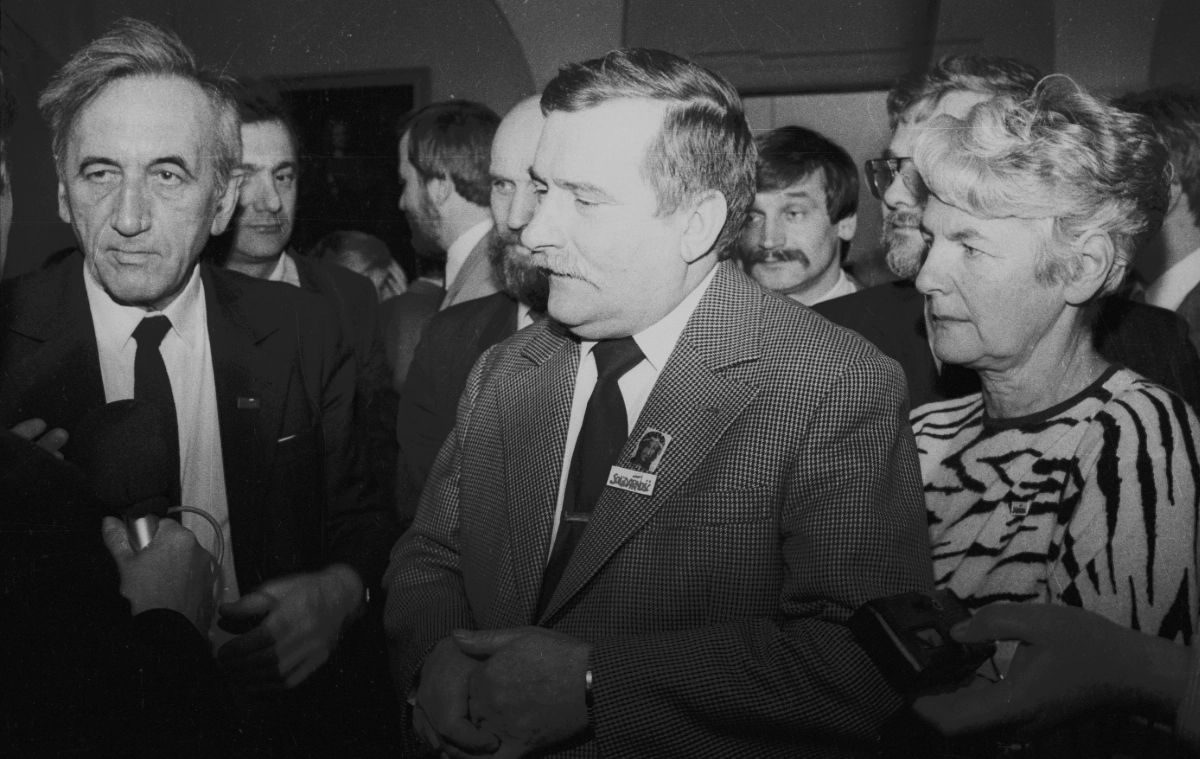
Zofia Kuratowska (first on the right) together with future Prime Minister Tadeusz Mazowiecki (left) and future President Lech Wałesa (centre) during the first day of the Round Table Talks in Warsaw, 1989 Sygnatura: OK_0895_0014_031
Expert work and activism
Kuratowska’s activism can be divided into two key areas. Firstly, since the early 1980s she had been an active member of the trade union Solidarność (Solidarity), for which she acted as both chair of her hospital’s branch and as a member of the union’s National Coordinating Committee of Health Workers. There, she campaigned for better working conditions for healthcare workers, modernisation of medical infrastructure, and improved treatment for patients. During the period of martial law from 1981 to 1983 she became an active member of the Committee for the Help of Internees and their Families (Komitet Prymasowski), visiting internment camps and acting as an observer of political trials. Between 1984 and 1989 she was one of the editors of the samizdat journal Zeszyty Niezależnej Myśli Lekarskiej (Journal of Independent Medical Thought). In 1989, Kuratowska became one of Solidarity’s representatives in the Round Table Talks, leading the sub-committee on public health challenges. In the first partially free parliamentary elections of June 1989, Kuratowska became a member of the Senate (the upper house of the Polish Parliament), and was later elected one of its vice-chairpersons. In the 1990s, she was an active politician of the liberal Democratic Union and Freedom Union parties, leading their social-democratic factions. In 1997, she became Ambassador of the Republic of Poland to South Africa, the country where she was to die from cancer two years later.
The second area of Kuratowska’s activism and expertise concerned the HIV/AIDS epidemic which spread globally in the 1980s and reached Poland in 1985. Kuratowska was the author of the first popular book on the subject in Poland, titled AIDS: nowa choroba (AIDS: a new disease, 1986) published in over 70,000 copies. Well-versed in the latest medical research on HIV/AIDS from the West, Kuratowska emphasised the importance of education and prevention in responding to the new public health challenges. She rejected the stigmatisation of so-called risk groups and instead called for tolerance and solidarity. In 1989, she co-founded the association “Solidarity with AIDS Plus”, the first NGO explicitly to address the question of HIV/AIDS in Poland. Working together with the esteemed Polish sexologist Mikołaj Kozakiewicz and the anti-drug charity worker Marek Kotański, she campaigned for social, therapeutical, and legal support for seropositive patients. In 1993, Kuratowska joined the newly created Social AIDS Committee, another Polish NGO founded to provide advice on HIV prevention and support for people living with the virus. In 1995, during a TV broadcast, she kissed a young man who suffered from AIDS on the cheek. Reporting on this event, a journalist emphasised that for Kuratowska “Politics is a weapon in the fight for equal rights, especially for people who are ‘different’, underprivileged.”
International engagement and networks
Throughout her career, Kuratowska was an active member of international medical associations. In 1962, she spent several months on a medical fellowship in Chicago. She presented her work at international conferences, and her networks of contacts facilitated international recognition of the political repression she faced for her criticism of the regime. When in 1983 she was demoted from her position as the director of the Geriatric Clinic in Warsaw, the Ministry of Health received several letters of support for Kuratowska written by influential French doctors; and articles about measures taken against her appeared in Western media outlets such as The Observer and the International Herald Tribune. In the 1980s, Kuratowska travelled several times to the USA, where she not only attended meetings about HIV/AIDS, but also delivered public lectures about the situation of political prisoners in Poland.
In the 1990s, Kuratowska became involved in international networks of parliamentarians, through the Parliamentary Assembly of the Council of Europe. In 1989, as vice-chairwoman of the Polish Senate, she participated in the anti-apartheid Conference for a Democratic Future held in Johannesburg in the Republic of South Africa (RSA). This marked the beginning of Kuratowska’s interest in South African anti-apartheid activism and her close observations of the democratisation processes in that country. She was a member of the Association of Western European Parlamentarians against Apartheid, involved in public education campaigns preceding the first democratic elections in the RSA. She also acted as an international observer during parliamentary elections in both the RSA and neighbouring Mozambique. Writing about her visits to South Africa, Kuratowska emphasized the intersectional character of racial discrimination and economic inequality in the country. She was also a vocal supporter of women’s political participation in democratization processes in RSA.
Research and activism with an emphasis on feminist knowledge
Influenced by the Catholic Church’s position on the issue, Kuratowska initially favoured arguments for restricting access to abortion. Later, portraying it as a “necessary evil,” she however vehemently argued for a woman’s right to decide about the continuation of a pregnancy. As a result, she became a vocal opponent of the new bills proposed in the Polish parliament to restrict access to abortion. She advocated for sex education and improved access to contraception. In both her 1990s activism and earlier samizdat publications Kuratowska emphasised the detrimental effects of environmental pollution and low standards of healthcare on women’s and children’s health, arguing that the state should take a much more active role in protecting vulnerable populations. In her medical publications and political speeches, Kuratowska always argued for a profoundly humanistic approach toward public health, emphasizing the importance of compassion and tolerance, but also high standards of medical care and professional behaviour.
Legacy and impact
In 1993, Kuratowska received the Polish “Woman of the Year” prize, awarded by the readers of the popular women’s monthly Twój Styl (Your Style). In an interview published in the magazine, she reflected on her life choices and political legacy. When asked about the roots of her professional and political success, she responded modestly: “Maybe I was lucky? Maybe because I have always been faithful to myself? I am very satisfied with my life”. Her career trajectory and activism demonstrate her strong commitment to gender equality, both in her private and public life. While her death cut short Kuratowska’s diplomatic career, her involvement with anti-apartheid activism in South Africa further illustrates the intersectional character of feminist knowledge production in which Kuratowska engaged: profoundly sensitive to the questions of gender, racial and economic inequalities.
Anna Dobrowolska
Selected Works
Kuratowska, Z., B. Lewartowski, and E. Michalak. “Studies on the Production of Erythropoietin by Isolated Perfused Organs.” Blood 18, no. 5 (1961): 527-34.
Kuratowska, Zofia. Krwinka-krew-życie. Warszawa: Wiedza Powszechna, 1971.
Kuratowska, Zofia. AIDS: nowa choroba. Warszawa: Wiedza Powszechna, 1986.
Bibliography
Biernacki, Krzysztof. “Zofia Kuratowska.” Encyklopedia Solidarności. Accessed November 27, 2025. https://encysol.pl/es/encyklopedia/biogramy/17135,Kuratowska-Zofia.html.
“Flesz historii: 25.09.2025.” Program, TVP VOD, accessed November 27, 2025, https://vod.tvp.pl/programy,88/flesz-historii-odcinki,284562/odcinek-1631,S01E1631,2392416
Jaszczuński, Grzegorz. Zofia Kuratowska: Lekarz, polityk, dyplomata. Warszawa: Oficyna Wydawnicza Rytm, 2000.
Kuratowska, Zofia. “Sześć razy RPA.” In Czarny prezydent. Rewolucja w RPA, by Grzegorz Jaszuński. Warszawa: Oficyna Wydawnicza Rytm, 1995.
Ośrodek Karta [Karta Centre]. Archiwum Opozycji [Democratic Opposition Archive]. Zofia Kuratowska’s personal collection, AO III/11K.
anti-racism | dissidence | environment | health | medicine | Poland | reproductive health