Věra Hájková
1924 - 1998
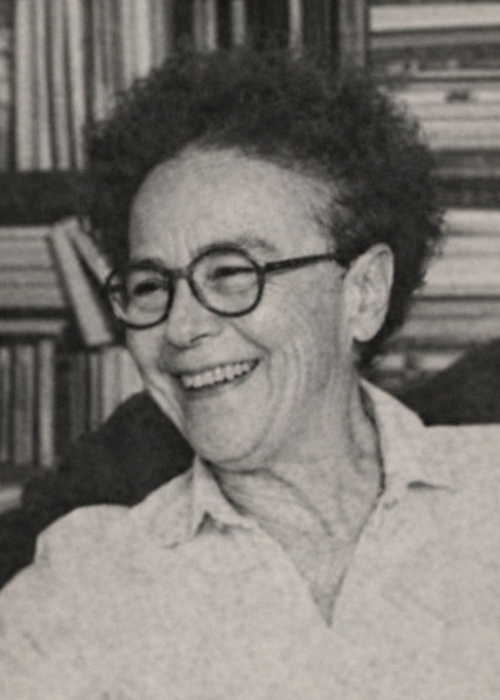
Photograph by Daniela Sýkorová, published in Alena Šloufová „Dlouhá cesta za poznáním.” Vlasta 44: 28 (1990): 7
“Arguing that women should return to the home and that men should earn more is unrealistic. Far greater prospects for success lie in the everyday, less spectacular work aimed at addressing the housing problem, securing a sufficient number of places in childcare facilities, improving their quality, easing domestic labour through the development of services, expanding retail networks, and reducing working hours for mothers of young children […]. Every advanced society—ours included—needs women for work, and women themselves want to work. Bewailing their situation may be a politically popular approach which can even seem flattering to women, but it is of no real use to our society. In the matter of women’s employment, there is no room for Hamlet-like dilemmas. What is required is to remove, step by step, the obstacles between a woman’s maternal role and her employment, just as it is necessary patiently to overcome the prejudices and superstitions accumulated over centuries.”
„Vykřikovat, že se ženy mají vrátit do domácností a mužům se má přidat, je nereálné. Daleko větší naději na úspěch má všední, méně efektní práce, směřující k řešení bytového problému, k získání dostatečného počtu míst v dětských zařízeních, k jejich zkvalitnění, usnadnění domácích prací pomocí rozvoje služeb, rozšiřování sítě obchodů, zkracování pracovní doby pro matky malých dětí […]. Každá vyspělá společnost — naši nevyjímaje — práci žen potřebuje a ony také pracovat chtějí. Lkát nad osudem žen je politika sice líbivá a pro ženy svým vlastním způsobem i lichotivá, jenže naší společnosti čerta platná. V problematice zaměstnanosti žen není dnes už hamletovských otázek. Jde o to, krok za krokem odstraňovat překážky mezi mateřským posláním ženy a jejím zaměstnáním, právě tak jako trpělivě překonávat předsudky a pověry nakupené staletími.“
Quoted from Hájková, Věra, and Anna Tučková. “Pranýř nebo pomoc? [Punishment or help?].” Kulturní tvorba: týdeník ÚV KSČ pro politiku a kulturu 3, no. 24 (1965).
Biography
Věra Hájková, née Duxová (1924 Olomouc, Czechoslovakia [today the Czech Republic] – 17 October 1998, Czech Republic) trained as a children’s nurse in the 1950s and 1960s and later became an outstanding editor of the widely-read Czechoslovak women’s magazine {glossary:Vlasta}. There, she wrote extensively about topics concerning women, children, and families, kindergartens, children’s homes, and marriage. She also wrote on serious issues including alcoholism, sex education, and the sexual abuse of children.
Social background and private life
Věra Hájková was the second child of a middle-class Jewish family. Her parents owned the fabric store Látky Dux, where her mother, Ilona Duxová, worked. In 1939, when Věra was 14 years old, her father Josef Dux, a member of the Olomouc Sokol leadership, died, and the family moved from Olomouc to Prague.
Věra had hoped to study medicine, but with the outbreak of war the universities were closed; for a Jewish girl, even high school was inaccessible. However, she regarded these circumstances as just “a wartime provisional arrangement” and, after completing municipal school, resolved to pursue any path connected to medicine. She enrolled on a course in neonatal nursing: as well as practical training in nurseries, at weekends Věra used to take home infants whose parents had “forgotten” to pick them up.
Through their mother’s sister, Věra and her brother became involved in the communist resistance. For two years, she copied and distributed leaflets, brochures, and books. In 1942, the eighteen-year-old Věra and her mother were deported to the concentration camp at Terezín. There she encountered a medical doctor from a neonatal course and was able to resume her work as a nurse . From Terezín, she was moved with her mother and brother to Auschwitz, where she continued her activities in the communist resistance. Her next transfer took her to Christianstadt, a sub-camp of Gross-Rosen. She survived both her internment, and the subsequent death march from Christianstadt to Bergen-Belsen. In the Holocaust, she lost almost her entire extended family.
Soon after the war, Hájková married a childhood friend who had served during the Second World War on the Western Front. In 1952— after a period of unemployment for both her and her husband—Věra found a new job with the women’s magazine Vlasta and worked there as an editor until 1969. The previous year, during the {glossary:Prague Spring}, she refused to withdraw opinions unfavourable to the Communist party. Only a week before the invasion, she wrote in Vlasta of those in leading positions that “their dilettantism in professional and political matters caused the gap between the nation and the Communist Party to widen ever more deeply. […] Such people led our country to economic and political decline.” Rather than be fired for her dissident opinion, she resigned.
In 1970, as a result of so-called {glossary:Normalization}, Hájková was expelled from the Communist Party for her disagreement with the {glossary:occupation of Czechoslovakia} by Warsaw Pact troops. After that, she could only work in manual jobs, such as cleaning. However, she continued to write, using as pseudonyms the names of her friends, the medical doctors Ladislav Zeman and Jiří Dunovský. She also wrote a memoir, That’s how life was, published in 1987 by writer and dissident Ludvík Vaculík as part of the samizdat series Petlice. Originally intended as a letter to her children, Hájková’s short autobiography was republished after the Velvet Revolution in 1991.
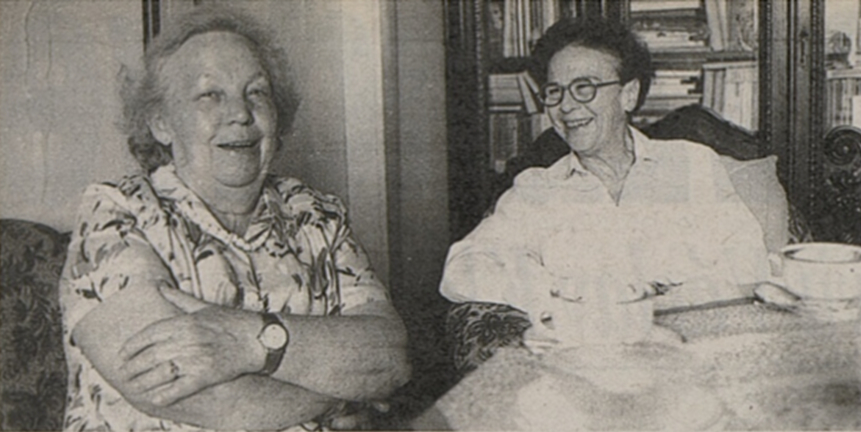
Věra Hájková (right) alongside Zdena Zajoncová, who also worked for the publication Vlasta. Photograph by Daniela Sýkorová, published in Alena Šloufová. „Dlouhá cesta za poznáním.” Vlasta 44: 28 (1990): 7
Expert work and activism
In Vlasta, Hájková systematically focused on institutionalized care for children. She criticized infant and children’s homes, where she believed children suffered emotionally, and advocated for family-based care through the humanitarian organization SOS Children’s Villages. She also addressed the issues of sex education, contraception, and abortion. She challenged the effectiveness of {glossary:abortion commissions}, which were unnecessary in two-thirds of cases because a positive decision was already clear in advance (i.e. when a woman already had several children, was over 40 years old, or suffered from health problems). At the same time, Hájková emphasized the psychological trauma that many women suffered from sitting before the commission due to the insensitive approach of its members. In her opinion, what was most needed was sex education and accessible contraception.
In the 1950s and 1960s, Hájková was responsible for the column “Nurse Helena Advises You”, where she used her experience as a pediatric nurse to give readers advice about health issues. Following a series of articles on alcoholism, she was approached by the desperate wives of a number of alcoholics, whom she tried to help through her contacts with the Ministries of Health and Social Affairs. She did not approve that children from alcoholic families – often siblings separated from each other – were sent to children’s homes, “while their drunkard fathers continued their destructive behavior without notice.” Instead, she believed that state authorities should take consistent action against alcoholics.
A further topic of interest was marriage. With demographer Jiří Prokopec, she collaborated on a survey called “Marriage and Me”, based on a questionnaire published in 1965 in the pages of Vlasta. In addition to 8,000 completed questionnaires, Hájková received more than 200 letters thanking her survey for initiating communication between couples about their marriage.
In 1966, the case of Jaroslav Papež, the sexual abuser and murderer of an eleven-year-old boy, was much covered in the press. Hájková responded by criticizing the ineffectiveness of existing punishments for sex perpetrators, which were generally light in comparison to penalties for theft of public property.
International engagement and networks
In 1967, Hájková visited Belgrade as a reporter, an assignment which greatly influenced her view of children’s homes. She was impressed by the Moshe Pijade Children’s Home, where groups of children of different ages lived in apartments with an ‘aunt’ or ‘uncle’, a principle of care intended to simulate raising children in a family environment. Hájková understood that in Czechoslovakia, where most orphanages resembled barracks, it was impossible to create a family-like atmosphere. Her report in Vlasta brought to public attention the concept of more sensitively-run children’s homes.
At around this time, Jiří Dunovský, a doctor from the Ministry of Health, invited Hermann Gmeiner (one of the founders of the first {glossary:SOS Children’s Villages in Austria}) to Prague; and Gmeiner’s description of the SOS scheme strongly reminded Hájková of her experience in Belgrade. Thanks to the contribution of Hájková, a movement for innovative forms of foster care, the Friends of the Children’s Villages Association, was established. As a consequence of Normalization, the association was banned in the 1970s. But two {glossary:SOS Children’s Villages in Czechoslovakia} were opened, and Hájková, in particular, played a key role in changing the understanding of institutional care. The magazine Vlasta was also instrumental in finding ‘aunts’ for the first village in Doubí.
Legacy and impact
In a 1990 interview for Vlasta, Věra Hájková wrote “I’ve had a really colorful life”. Her work as a journalist was always linked to her efforts to improve the lives of children and women. She was not afraid to raise serious issues in the pages of the magazine, and took advantage of the period of comparative political relaxation in the 1960s to do so. Although her work at Vlasta ended with the onset of Normalization in 1969, many grateful Czech readers remembered her work in the later post-revolutionary period. When Hájková died in 1998, Vlasta wrote: “Nurse Helena has left us […] the editor Věra Hájková, a wonderful woman who combined tremendous sensitivity and kindness with journalistic professionalism.”
Marie Láníková
Selected Works
Hájková -Duxová, Věra. “Takový to byl život [That’s how life was].” In Svět bez lidských dimenzí: čtyři ženy vzpomínají [A world without human dimensions: four women reminisce]. Státní židovské muzeum v Praze, 1991.
Hájková, Věra. “Ohlas na Temné kouty [Response to Dark Corners].” Vlasta 20, no. 49 (1966): 11.
Hájková, Věra. “Temné kouty [Dark Corners].” Vlasta 20, no. 40 (1966): 4–5.
Hájková, Věra, and Anna Tučková. “Pranýř nebo pomoc? [Punishment or help?].” Kulturní tvorba: týdeník ÚV KSČ pro politiku a kulturu 3, no. 24 (1965).
Bibliography
Bělehradová, Andrea, Marie Láníková, and Kateřina Lišková. “‘Dark Corners’: Child Sex Murder, Forensic Expertise, and Protective Treatment in Socialist Czechoslovakia.” Journal of the History of Medicine and Allied Sciences, no. 20 (2025): 1–21. https://doi.org/10.1093/jhmas/jraf011
abortion | alcoholism | child protection | childcare | Czechoslovakia | journalism | marriage | nursing | sexual abuse