Teresa Pałaszewska-Reindl
1928 - 2023
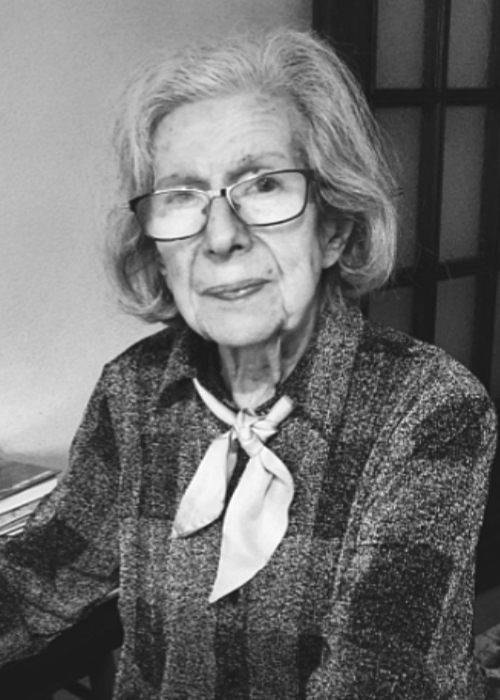
Photograph: Tomasz Reindl; courtesy of Tomasz Reindl
“The drudgery of basic household chores consumes the time and energy of women, who, in our family model, are burdened with most domestic responsibilities even though they have increasingly entered the workforce. This does not allow women to expand their knowledge and qualifications or to fulfil their educational and caregiving roles within the family. At the same time, it negatively impacts their health and ability to work intensively. Performing basic household tasks while working results in an excessive increase in women’s actual working hours. And as research shows, rest and sleep are mainly affected. This situation requires fundamental changes.”
“Uciążliwość podstawowych prac domowych pochłania czas i energię kobiet, które w naszym modelu rodzinnym obarczone są większością obowiązków domowych, mimo iż w coraz większym stopniu pracują one zawodowo poza domem. Nie sprzyja to ani podnoszeniu wiedzy i kwalifikacji kobiet, ani spełnianiu funkcji wychowawczo-opiekuńczych w rodzinie, obniżając jednocześnie poziom zdrowotności o zdolności do intensywnej pracy. Wykonywanie podstawowych funkcji w gospodarstwie domowym przy równoczesnej pracy zawodowej prowadzi do nadmiernego wydłużania faktycznego czasu pracy kobiet. I jak wykazują badania – odbywa się głównie kosztem wypoczynku i snu. Ta sytuacja wymaga zasadniczych przekształceń”.
Quoted from Pałaszewska- Reindl, O dalszy postęp i racjonalizację w gospodarstwie domowym [For further progress and rationalization in the household], Gospodarstwo Domowe [Home Economics] (1971) 6, 1-2
Biography
Teresa Pałaszewska-Reindl (26 September 1928, Łódź – 10 December 2023, Warsaw) was a Polish economist whose research focused on consumption, home economics and the role of marketing and advertising in the socialist economy. She was the author of pioneering works on consumer practices during the economic crisis as well as one of the founders of the consumer movement in Poland.
Social background and private life
Born in Łódź, Teresa Pałaszewska was the daughter of Eugeniusz Pałaszewski, a craftsman, and his wife Genowefa, née Sobieska. In 1940, after Łódź fell to the Nazis and was renamed Litzmannstadt, the family was forcibly relocated to Warsaw. Following the Warsaw uprising of 1944, Pałaszewska was deported to the Nazi concentration camps of Mauthausen, Ravensbrück and Buchenwald. At the end of the war, she returned to Warsaw and graduated from Juliusz Słowacki High School in 1947. From 1947 to 1954, she studied at the Main School of Planning and Statistics and graduated with a master’s degree. In 1961, she married Tadeusz Reindl, one of the founders of the Institute of Industrial Design; and in 1970 gave birth to their son, Tomasz.
Education and professional path
As early as 1950, even before defending her master’s thesis, Pałaszewska started working at the Institute of Trade and Collective Nutrition, which in 1976 was transformed into the Institute of Internal Trade and Services (renamed in 1983 as the Institute of Internal Market and Consumption). In 1965, she obtained her doctorate in economics, based on the thesis “Consumption of durable goods as an element of economic growth”. She became an associate professor in 1984 and a full professor in 1994. Besides her research work at the Institute of Internal Trade and Consumption, she conducted teaching activities at the Main School of Planning and Statistics during the years 1952 to 1957, 1968 to 1970 and 1973 to 1977. During the 1960s and 1970s, she taught numerous courses for the Ministries of Internal Trade and Services, Labor and Social Affairs, and Finance, as well as for cooperative organizations such as “{glossary:Społem}”. From 1985 onwards, she was employed at the {glossary:Warsaw University of Life Sciences} as head of the Home Economics Department.
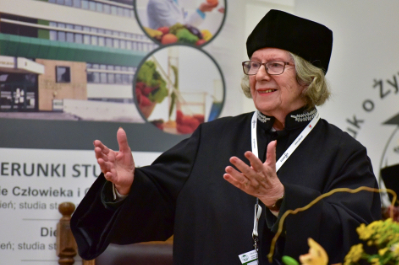
Prof. Teresa Pałaszewska-Reindl (Fot. Tomasz Reindl) / Courtesy of Tomasz Reindl
Intellectual influences
When Pałaszewska-Reindl started her academic career, home economics and consumption were not popular fields of research. Her work, however, was considered highly innovative, which is why she was hired as the head of the Home Economics Department at SGGW. Since home economics was associated with food and nutrition research, she collaborated with Stanisław Berger, one of the founders of the Faculty of Agricultural and Food Technology. As a leader of several so-called node projects, Pałaszewska-Reindl gathered researchers from various backgrounds around her. She encouraged her younger academic colleagues as well as PhD students to take up innovative topics such as the role of marketing in the socialist economy, changing consumption patterns, and coping strategies during times of economic crisis. In this way, she contributed to building a community of researchers focused on home economics at the SGGW. For this reason, she is remembered for being very supportive, especially towards young scientists.
Expert work and activism
Throughout her work at the Institute of Trade and Collective Nutrition (later the Institute of Internal Market and Consumption) Pałaszewska-Reindl addressed the problems of consumption in the socialist economy. At SGGW, she initiated multidisciplinary research on the consumer behaviors of individual households and on the role of marketing in a centrally-planned economy. She was one of the first to investigate the relationship between consumption and the transformation of the Polish economy after 1989, and to raise the subject of consumer rights. In addition to her research activities, she was president of the Polish branch of a global company specializing in market research.
From the beginning of her academic career, she was active in professional and social organizations, such as the Polish Economic Society, the Polish Sociological Association, and the Polish Society of the Household Economics. She was among the founders of the Polish Society of Marketing (established in 1976), and the Consumer Federation (established in 1981). During the years 1971 to 1985 she worked as an editor of the journal “Handel Wewnętrzny” (Internal Trade). As well as this, she was active in the Trade Union of the Employees of the Trade and Cooperatives from 1950 to 1981. From 1970 to 1974 she was a member of the Main Board of the {glossary:League of Women (Liga Kobiet)}. She regularly contributed to Gospodarstwo Domowe (Home Economics) – a bimonthly published by the Home Economics Committee affiliated to the League.
International engagement and networks
Pałaszewska-Reindl participated in numerous international conferences, both in the Eastern bloc and the West, developing strong connections primarily with academic partners in France, Germany and the United States. From the late 1970s to the mid-1980s she represented Poland in the Demand Research Working Group of the {glossary:COMECON} and in the {glossary:International Federation for Home Economics (IFHE)}. In 1993 she became an honorary member of the {glossary:Kappa Omicron Nu} society, which brought together home economics lecturers in the US. In the same year, together with the French partners, she developed the curricula for a one-year postgraduate study of marketing and management in agribusiness.
Research and activism with an emphasis on feminist knowledge
Initially, Teresa Pałaszewska-Reindl’s academic and organizational activities were not focused on women’s issues. However, as soon as her research began to focus on individual households, she started to address problems such as unpaid work performed by women and the relationship between women’s professional activities and their domestic roles. In articles published by Gospodarstwo Domowe in the 1970s and 1980s, she advocated for modernizing housework to release women from their double burden. During the 1980s, she recognized the gendered aspects of Poland’s economic crisis. In her fundamental work Polish Households. Everyday Life during the Crisis (1986) she argued that women were the most affected by the crisis because the adaptive strategies that were developed placed a disproportionate burden on them. In this way, the economic crisis strengthened beliefs about traditional gender roles within the family.
Legacy and impact
Teresa Pałaszewska-Reindl authored about 200 monographs, articles, book chapters and reviews. She contributed to the development of home economics as an academic discipline and initiated multidisciplinary research on the consumption and consumer behaviors of individual households. Although gender was not a central focus of her research, she recognized its importance in her analysis.
Katarzyna Stańczak-Wiślicz
Selected Works
Teresa Pałaszewska-Reindl, Konsumpcja dóbr trwałego użytku w Polsce, [Consumption of durable goods in Poland] Warsaw: Państwowe Wydawnictwo Ekonomiczne, 1966
Teresa Pałaszewska-Reindl (ed.), Konsumpcja w gospodarstwach domowych lat osiemdziesiątych: praca zbiorowa, [Household consumption in the 1980s: collective work] Katowice: Akademia Ekonomiczna, 1992
Teresa Pałaszewska-Reindl (ed.), Polskie gospodarstwa domowe: życie codzienne w kryzysie: praca zbiorowa, [Polish Households: Everyday Life during the Crisis: collective work] Warsaw: Instytut Wydawniczy Związków Zawodowych,1986.
Bibliography
Krystyna Gutowska, Profesor Teresa Pałaszewska-Reindl „Agricola. Pismo SGGW” 2024, nr 116, s. 46- 48
consumption | economic crisis | home economics | Łódź | Poland | unpaid work | Warsaw