Izabela Bielicka
1915 - 1995
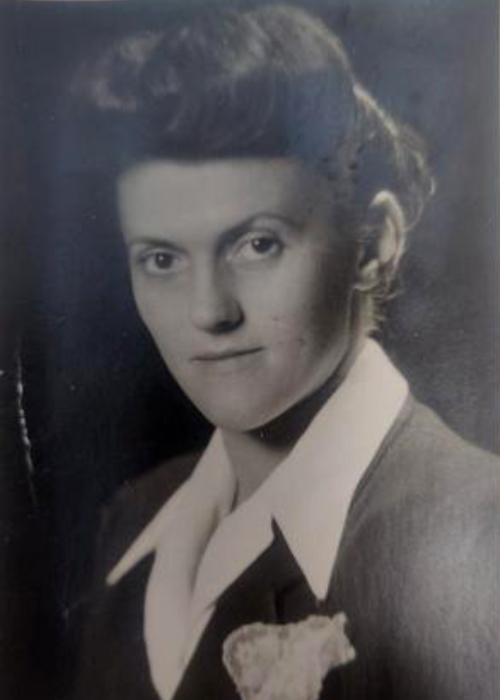
Archive of the Warsaw Medical University, sygn. 3501
“When speaking about the feelings of a mother and father for their child, we often habitually use stock expressions such as ‘maternal love’, ‘maternal tenderness’, ‘maternal care’, but in relation to fathers ‘paternal pride’, ‘paternal authority’, ‘the strong hand of the man’, etc. But this mode of expression is an outdated one, created during the time of the patriarchal family, when the balance of family life was based on the strict division of the roles of father and mother. (…) The authority of parental strength no longer works in our time. Only the authority of friendship and respect remains effective.”
“Mówiąc o uczuciach matki i ojca do dziecka, używamy często drogą nawyku słów-szablonów, na przykład miłość macierzyńska, czułość macierzyńska, opieka macierzyńska, zaś w stosunku do ojców raczej duma ojcowska, autorytet ojcowski, silna ręka mężczyzny itp. A przecież szablon to przestarzały, który powstał w czasach rodziny patriarchalnej, gdy równowaga życia rodzinnego opierała się na ścisłym podziale ról ojca i matki. (…) Autorytet siły rodzicielskiej przestał działać w naszych czasach. jedynie skuteczny został autorytet przyjaźni i szacunku.”
Izabela Bielicka, Porozmawiajmy o uparciuchach (Warszawa: Państw. Zakł. Wydaw. Szkolnych, 1964)
Biography
Izabela Bielicka, also Isabella Bielicki (20 February 1915, Vilnius, Russian Empire (now Lithuania) – 1995, Mainz, Germany) was a professor of pediatrics who contributed to establishing healthcare infrastructure and treatment for prematurely born babies in early post-war Poland, and later focused on the psychological problems of childhood. She highlighted the role of both parents in the proper emotional and mental development of the child, arguing for a new, more engaged model of fatherhood.
Social background and private life
Bielicka was born into a Polish-Jewish middle-class family in Vilnius. Her father was a clerk in a mill. From 1933 to 1938 Bielicka studied medicine at the Stefan Batory University in Vilnius (then Poland), at a time of increasing antisemitism at the University and in the country. She met her future husband Zygmunt Bielicki (Samuel Szapiro) at the faculty, and they married soon after graduating. After finishing their internship, they moved to Jabłonna near Warsaw where they worked as physicians. After the outbreak of World War Two, they fled to Korets ukr. Корець, Koreć) in Soviet-occupied Eastern Poland (today Ukraine), where they worked in the city hospital. The outbreak of the Soviet-German war in 1941 separated the spouses.
Bielicka remained for some time in Vilnius, and in 1944, she served as a doctor in the Byelorussian partisan movement, a service for which she received the Partisan Cross in 1948. She lost all her birth family members in the Holocaust. Her husband was mobilized to the Red Army, rising to the rank of major, and in 1945, he was transferred to the Polish Army. The couple had three sons, born in 1940, 1948, and 1950.
Education and professional path
Bielicka’s academic and professional career advanced rapidly after the war. In 1946, she defended a doctoral thesis while working at a hospital in Poznań. She followed her husband, who was appointed in Warsaw as a military officer responsible for healthcare. From January 1947, Bielicka was employed as an assistant in the pediatric clinic at the University of Warsaw, and, from 1950, at the Institute of Mother and Child. In the latter institution, she became the head of the Department of Pediatrics. In 1951, she further advanced in the academic hierarchy, defending a habilitation dissertation. In 1954, she received the degree of docentura but was denied a professorship on the grounds that her work, which leaned towards solving practical problems, was considered to have “social” rather than “scientific” significance.
In 1958, Bielicka became the head of the Department of Social Pediatrics at the Medical Academy in Warsaw, for which she gave up her second post at the Institute of Mother and Child. However, this established career ended abruptly. Amid the anti-Semitic campaign of {glossary:March 1968} conducted by the Polish party-state authorities, she was removed from her position and emigrated with her family to West Germany. There, she continued her activity as a pediatrician under the name “Isabella Bielicki”, publishing advice books for parents on upbringing. She held a position as chief physician at the Clinic for Child and Family Therapy in Idstein until 1970.
Expert work and activism
In her research and practical work, Bielicka focused on fighting high infant mortality rates, one of the main challenges of the early post-war healthcare system in Poland. In particular, she worked intensively to establish standards of care for prematurely-born children. She worked in two of the first wards for premature babies in Warsaw and published extensively about the topic from the late 1940s onwards. Bielicka’s interests quickly evolved towards children’s mental development. In an outpatient clinic affiliated with the Department of Social Pediatrics she treated “orphan syndrome” cases in children. In the 1960s, Bielicka became very active in the public sphere, writing dozens of articles for the women’s magazine {glossary:Kobieta i Życie (Woman and Life)}, giving talks on the radio, and publishing seven advice books for parents in the years 1962-1968. She co-authored three educational film scripts for films directed by Janina Żukowska. Inspired by the concept of “maternal deprivation” and “hospitalism”, introduced to the international expert audience by Austrian-US psychoanalyst René Spitz and British psychiatrist John Bowlby, Bielicka argued for the crucial role of emotional bonds in the family for the healthy development of the child. She was in favor of upbringing without any violence, emotional coldness, or humiliation.
International engagement and networks
Bielicka had broad international connections and traveled frequently. Her knowledge of French, Russian, German, and English facilitated these encounters. In 1947, at the invitation of the World Health Organization, she benefited from a three-month stay at the pediatric clinic of Robert Debré in Paris. She received training in Switzerland as well as the Soviet Union. Her international activity flourished again after 1956, with travels to London (where she was in touch with John Bowlby), Paris (to the Centre international de l’enfance), Prague and Moscow. She exchanged visits with Slovenian criminologist Katja Vodopivec. Bielicka’s research and practice were much influenced by Soviet medicine, as well as French, British, and Czechoslovak psychiatry and psychology. Bielicka was part of the Polish delegation to the 1955 {glossary:Women’s International Democratic Federation} Congress of Mothers in Lausanne, where she joined the expert commission on health.
Research and activism with an emphasis on feminist knowledge
In her early work, Bielicka underlined the importance of pregnancy care and new protective legislation for pregnant women workers, connecting the health of the child with the well-being of the mother. She argued that women’s participation in employment has a positive impact on their health, not only because working women have better access to healthcare, but also because “Professional employment, by providing women independence and a sense of self-esteem, ensures, besides health, moral satisfaction and psychological balance.”
The concept of “maternal deprivation” often led to a rejection of collective care such as nurseries for the children of working mothers. Bielicka’s reception of this theory, however, did not lead her to such conclusions, but rather to a new conceptualization of parenthood. For Bielicka, the roots of developmental and psychological problems of children did not lie in women’s work or nurseries but in bad parenting. She often talked about “parental deprivation” rather than “maternal deprivation,” and highlighted the role of emotionally-engaged fatherhood, rejecting the traditional model of a father who is violent, absent, or uninterested.
Legacy and impact
Bielicka’s work contributed greatly to the development of professional healthcare for newborns and, especially, premature babies in Poland. Her ideas about the emotional development of the child and engaged fatherhood were very progressive for her time. Despite the importance of her contribution, she is not particularly well known or remembered in Poland.
Natalia Jarska
Selected Works
Izabela Bielicka, Rozważania nad kołyską [Reflections over the cradle] (Warszawa: PZWSz, 1962).
Izabela Bielicka, Porozmawiajmy o uparciuchach [Let’s talk about stubborn children] (Warszawa: PZWSz, 1964).
Izabela Bielicka, Miłość macierzyńska pod mikroskopem [Maternal love under the microscope] (Warszawa: PZWL, 1967).
Izabela Bielicka, Zagadnienia z patofizjologii, leczenia i pielęgnowania wcześniaków w świetle spostrzeżeń własnych [Pathophysiology, treatment, and care of premature infants in the light of observations] (Warszawa: PZWL, 1951).
Bibliography
Jose Luis Aguilar López-Barajas, Natalia Jarska, “Gender, women’s emancipation, and socialism in the lives of two paediatricians: a comparative look at East Germany and Poland,” European Journal for the History of Medicine and Health [forthcoming]
Lišková, K., Jarska, N., Gagyiova, A., Aguilar López-Barajas, J. L., & Rábová, Š. C. (2023). Saving newborns, defining livebirth: The struggle to reduce infant mortality in East-Central Europe in comparative and transnational perspectives, 1945–1965. History of Science, 62(2), 252-279. https://doi.org/10.1177/00732753231187486
childcare | fatherhood | medicine | motherhood | Poland | psychology