Irena Gumowska
1912 - 1991
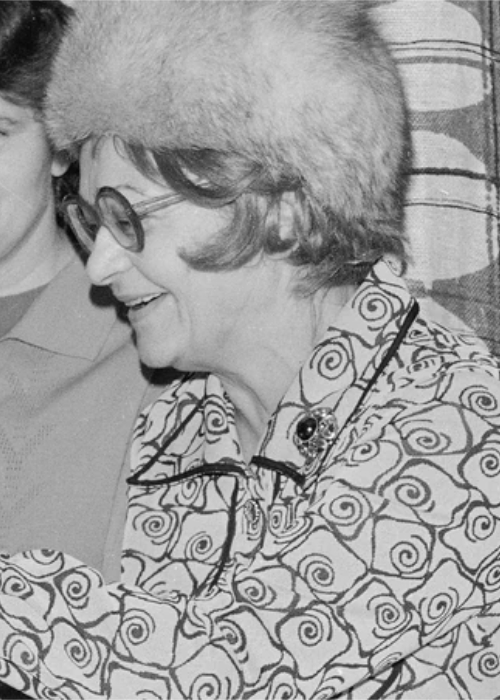
“Expert knowledge is much more easily and pleasantly assimilated in the company of an anecdote, a curiosity, an unknown biographical detail”
„Wiedzę fachową znacznie łatwiej i milej przyswaja się w powiązaniu z anegdotą, ciekawostką, nieznanym szczegółem biograficznym”
Quoted in: A. Bańkowska, O sprawach nie tylko dla kobiet…pisze mgr inż. Irena Gumowska, Poradnik Bibliotekarza 1962, no 11-12, s. 359
Biography
Irena Gumowska, also Gumowska-Dąbrowska, (1912 Krakow – 1991 Warsaw) was an agricultural engineer by education, and later a journalist widely known as an expert on lifestyle, home economics, nutrition and the aesthetics of everyday life. She authored 42 books on a wide range of topics, including lifestyle, savoir-vivre, the aesthetics of everyday life, cooking and dieting, natural therapies and preventive healthcare.
Social background and private life
Gumowska was born in Krakow into the well-off family of Marian Gumowski, a historian and landowner in the Wielkopolska region, and Eliza, née Barańska. Marian Gumowski was a professor of history, and the author of significant publications on numismatics and stratigraphy. From 1945 he worked at the Nicolaus Copernicus University in Torun. Eliza Gumowska worked at home and cared for her four children. She died of typhoid during the Second World War.
Very little is known about Irena’s personal life. She married Stefan Dąbrowski, head of the publishing department of the Institute of Mental Hygiene, and gave birth to their son, Adam. She always used her maiden name ‘Gumowska’ to sign her publications.
Education and Professional Path
Irena graduated from the General Zamoyska High School in Poznan, and from 1933 to 1937 studied at the Faculty of Agriculture at the Jagiellonian University in Krakow, where she received her master’s degree in agriculture. Additionally, she completed a course in social agronomy, and in 1939 began working as a home economics instructor for the circles of rural housewives. According to her self-written curriculum vitae, during the Nazi occupation (1939 to 1945) she became a student of psychology and mental hygiene at the underground Institute of Mental Hygiene and Applied Psychology in Zagórze near Warsaw. At the same time, she worked as a local agronomist, specializing in the problems of rural households. After 1945, Gumowska moved first to Lublin, then to Warsaw and started work as a journalist, focusing on the problems of the household. Until September 1946 she ran a women’s column in Sztandar Ludu, a daily newspaper published by the {glossary:Polish Workers’ Party (PPR)}. In Warsaw she contributed to {glossary:Dziennik Ludowy (People’s Daily)}, signing her articles on household management with her initials and the title of ‘Engineer’.
She joined the {glossary:Socio-Civic League of Women (SOLK)}, and from February 1946 to October 1947 was editor-in-chief of the bi-weekly {glossary:Kobieta Dzisiejsza (Today’s Woman)} published by the League. She was also involved in the works of the Institute of Home Economics, which operated under the auspices of the League, and began to cooperate with the Warsaw University of Life Sciences. This gave her the opportunity to combine her social activity with her academic ambitions and interest in the university’s discipline of ‘{glossary:Euthenics}’. Gumowska entered the Home Economics program, which operated within the Department of Horticulture from 1946 to 1949, and in 1948 she submitted an application to start her Ph.D. under the supervision of the head of the program, Professor Maria Gutowska. The Home Economics program was closed down in 1949, and as a result Gumowska was unable to complete her Ph.D. studies. Due to what she later called ‘personal conflicts’, she lost her position at the Institute, which was dissolved in 1950 as a result of the Stalinist policy of unifying women’s organizations.
From the early 1950s, she focused on her career as a journalist. In Kobieta, she published articles on nutrition, eating habits and modernizing the kitchen space, again signing them with her professional title “Engineer”. She regularly contributed to {glossary:Przyjaciółka (Girlfriend)}, the most popular women’s magazine in socialist Poland; and from the early 1960s she had her own column, “Dla każdego coś dobrego” (“Something good for everyone”). She also participated in radio and television programs.
In the mid-1950s Gumowska started publishing high-circulation books that popularized expert knowledge, first on agriculture, then on home economics, nutrition and dieting. She quickly became a recognized popular expert and an authority in these areas. Although written in an informal style with a lively narrative, her books were founded on professional research and introduced the general public to the latest concepts in nutrition, preventive healthcare, and the fundamentals of psychology.
International Engagement and networks
After giving up her academic career, Gumowska did not belong to any formal academic networks. However, prominent Polish doctors including Professor Stanisław Józef Grochmal, a neurologist from Krakow, as well as nutritionists and home economists, continued to cooperate with her as a consultant. According to her own account, she took various courses and established contacts with American experts during her visits to the United States, which gave her access to foreign publications. Gumowska was interested in the new trends in “natural medicine” and recommended massages, herbal medicine and alternative therapeutical methods such as acupressure. In this field she cooperated with Jadwiga Górnicka, a doctor and expert in natural therapies.
Prevention and healthcare were the focus of Gumowska’s publications on health and nutrition. In her books on lifestyle and housekeeping, she promoted the time-saving, efficient model of the American household, criticizing traditional methods of housekeeping and emphasizing the need to modernize Polish homes. She also promoted modern beauty culture, including dieting and anti-ageing techniques for men as well as women.
Research and Activism with an Emphasis on Feminist Knowledge
Although not an activist, Gumowska was a member of the Socio-Civic League of Women and, from 1948, of the {glossary:League of Women (Liga Kobiet)}. From the beginning of her career, she focused on so-called women’s issues, and it was problems such as women’s double burden, as well as unpaid reproductive work, that led her to the idea of modernizing the household with a more efficient model managed by women, based on the equal division of labour and the use of time-saving appliances. She advocated for the right of women to work outside the home, and emphasized that their mass entry into the paid workforce required a redefinition of the gender roles within the family. She argued that “a woman who works like a man, just like he does, does not have time to worry only about the kitchen” (Kobieta 1948, 11, p. 22), and promoted the partnership family model.
Legacy and Influence
Irena Gumowska was a ‘popular expert’, an advocate of gender equality and women’s interests in the sphere of everyday life. In her widely read books, she promoted expert knowledge and provided practical advice on how to incorporate it into daily life. She was a true authority in her field and was well known for her appearances in various media outlets.
Katarzyna Stańczak-Wiślicz
Selected Works
Gumowska, Irena, Od ananasa do ziemniaka : mały leksykon produktów spożywczych [From pineapple to potato: a small lexicon of foods], (Warszawa: Instytut Wydawniczy CRZZ, 1976)
Gumowska, Irena, Sztuka życia [The Art of Living], (Warszawa: Towarzystwo Wiedzy Powszechnej, 1967)
Gumowska, Irena, My i nasz dom [We and our home], (Warszawa: Wiedza Powszechna, 1956)
Gumowska, Irena. Venus z patelnią [Venus with a frying pan], (Warszawa: WPL, 1959)
Bibliography
Bańkowska, Anna, O sprawach nie tylko dla kobiet…pisze mgr inż. Irena Gumowska, [Irena Gumowska, MSc Eng., writes on matters not only for women] „Poradnik Bibliotekarza” [Librarian’s Guide] 1962, no 11-12, p. 359-363.