Helena Strzemińska
1931 - 2024
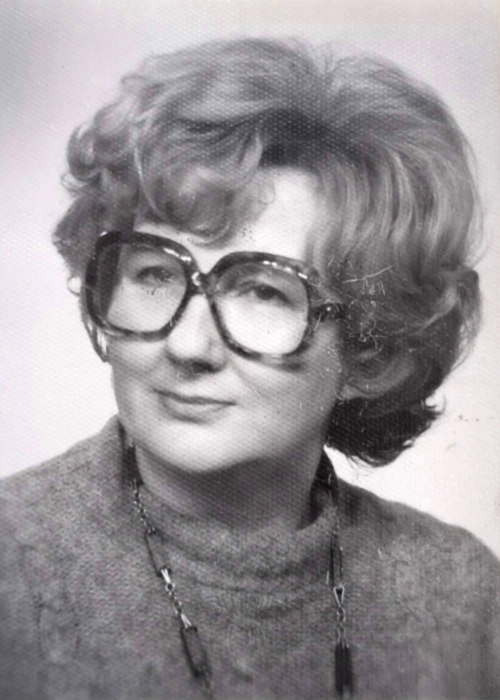
Archive of Modern Records in Warsaw, sygn.1681/0/4/616/21
The dual responsibilities of working women—professional and domestic—require them to devote most of their day to fulfilling them. In the time budget of the average woman, work (including professional work, commuting, and domestic work) accounts for: 14 hours and 54 minutes in the group of blue-collar workers, 12 hours and 33 minutes in the group of office workers, and 12 hours and 55 minutes in the group of shop assistants.
Podwójny zakres obowiązków pracującej kobiety – zawodowych i domowych – wymaga poświęcenia większej części doby na ich wykonanie. W budżecie czasu statystycznej kobiety praca (łącznie – zawodowa z dojazdami i domowa) stanowią pozycję równą: 14 godzin 54 minuty w grupie robotnic, 12 godzin 33 minuty w grupie urzędniczek, 12 godzin 55 minut w grupie ekspedientek.
Quoted from: Strzemińska, „Budżet czasu robotnic, urzędniczek i ekspedientek” [Time budget of blue-collar workers, office workers and shop assistants] in: Kobieta współczesna: z badań socjologów, lekarzy, ekonomistów, pedagogów i psychologów [The contemporary woman: from the research of sociologists, doctors, economists, educators and psychologists]. Edited by Magdalena Sokołowska (Warszawa: Książka i Wiedza, 1966), p. 216.
Biography
Helena Strzemińska (15 January 1931, Siedlce, Poland – 23 December, 2024, Warsaw, Poland) was an economist and expert on time-budget studies. In the 1960s, she was one of the first scholars to address the problem of working women’s time budgets in Poland. A large part of her academic research and career was dedicated to the topic of humanization of work (making work systems more humane, prioritizing the well-being of the worker), new forms of work organization, and the shortening of the working week.
Social background and private life
Helena Strzemińska was born into a family of the intelligentsia as Helena Wielogórska. She was married and had a son.
Educational and professional path
She graduated in economics from the {glossary:Main School of Planning and Statistics (SGPiS)} in Warsaw in 1956 and started to work at the Ministry of Higher Education, contributing to research on the living conditions of students and faculty members in Polish higher education. From 1962, she was employed at the Institute of Labor (later the Institute of Labor and Social Affairs) in Warsaw, to which she was affiliated throughout her academic career. She did not belong to any political party.
Expert work and activism
At the Institute of Labor in the 1960s, Strzemińska conducted research on women worker’s time budgets; this type of study aimed to collect data on the time allocated to various categories of activities throughout the day and the week. From the 1970s onwards, Strzemińska became interested in research on leisure time and the reduction of the working week (at that time, the working week in Poland was 46 hours long, one of the longest in both capitalist and socialist Europe). In 1978, she was awarded her habilitation based on research devoted to this topic and became the head of the Department of the Humanization of Work at the Institute of Labor. She authored expert reports for the government, parliamentary commissions, and trade unions. She advocated for a five-day-long working week (including so-called “free Saturdays”), drawing on the experience of some Eastern and Western countries in shortening the working week. When the reform of the Polish working week was introduced in 1981 (with two “free Saturdays” each month), she engaged in research on its impact; and in her book published in 1988 under the title Working time and leisure time in social policy, she pointed out significant shortcomings of the reform. In recognition of the impact of this work, Strzemińska was awarded the title of associate professor.
Throughout her long academic career, she published numerous articles and research reports in Polish, English, and French. She also published and gave interviews in the popular press, for example in magazines such as Życie Gospodarcze (Economic Life), Polityka (Politics), and Trybuna Ludu (People’s Tribune). After the political transformation of 1989 in Poland, Strzemińska remained academically active until the 2010s, continuing to research time management and work. Throughout her academic trajectory, she was involved in international networks and incorporated an international and comparative perspective into her analysis.
International engagement and networks
In the mid-1960s, as an expert on time-budget studies, Strzemińska was invited to participate in an {glossary:international study on time budgets} coordinated by the Hungarian sociologist Alexander Szalai and the European Coordination Center for Research and Documentation in Social Sciences in Vienna, supported by UNESCO. She collaborated with the Institute of Philosophy and Sociology of the Polish Academy of Sciences, where the Polish part of the project was affiliated. In this international project, she met and collaborated with Zsuzsa Ferge and contributed research papers at in international conferences including those at Evian (World Congress of Sociology, 1966) on socio-professional structure and time budgets, Vienna (1967), and Brussels (the 1973 UNESCO conference). She also contributed to the final edited volume of the international team, “The Use of Time”, published in 1972.
In the 1970s and 1980s, Strzemińska was involved in international networks of experts in work management. She participated in the conferences of a number of international research and social policy institutions and networks. Among others, she took part in a series of conferences devoted to the participation of women in science and technology (GASAT – Gender and Science and Technology), held in the 1980s. In 1985, she participated in the European Conference on Women, Natural Sciences and Technology in Elsinore (Denmark) with a contribution on women’s participation in the work humanization process; and in 1987, the GASAT conference in Haifa.
Research and activism with an emphasis on feminist knowledge
Strzemińska embarked on a study of women’s time budgets in the early 1960s, when time budget studies were gradually becoming popular in Poland. She not only measured the time that working women dedicated to different kinds of activities, including paid work and unpaid housework, but also interviewed women about their motivations to work outside the home. This study, published in 1964, revealed that on weekdays, female blue-collar workers devoted 15 hours per day to work, while white-collars spent over 12 hours. Based on the interviews, Strzemińska argued that paid employment had emancipatory potential for women, and that the state should therefore invest in developing services to alleviate the burden of housework. In the 1960s, Strzemińska was part of the interdisciplinary seminar on women’s work led by sociologist Magdalena Sokołowska at the Polish Academy of Sciences, and contributed to the edited volume “Contemporary Woman” (1966) with a chapter on time budgets of female blue-collar and white-collar workers and shop assistants. She also participated in a conference organized by the {glossary:League of Women (Liga Kobiet)}. Findings from her research were widely referenced and used in debates about women’s work.
Drawing on the research for the international time-budget study, Strzemińska authored another academic book titled “Women’s professional employment and their time budget”, based on her doctoral dissertation (defended in 1967) and published in Polish in 1970. Combining comparative international material with numerous Polish studies, she not only provided a complex picture of women’s engagement in reproductive work but also defended the right of women to professional fulfillment. She argued that women make conscious choices regarding their employment and childcare, that they do not work only because of economic reasons, and that “the research does not confirm that women’s professional work has a negative impact on household and children.” These arguments contradicted the popular opinion post-1956 that for their own good, women should concentrate on the household rather than fully engage in professional life. Instead, to solve the problem of reproductive labor, Strzemińska demanded the development of services and a modernizing of household and housework. She also proposed that mothers of small children should be able to leave their job if they wished.
In the 1970s and 1980s, when Strzemińska embarked on research on working time, she still published articles devoted to gendered topics such as the development of services and the sharing of housework between men and women. As already mentioned, she contributed to international networks Gender and Science and Technology in the late 1980s.
Legacy and impact
Helena Strzemińska was an expert who combined academic research with social engagement and advocacy. In the 1960s, she was the most important expert researching women’s time budgets in Poland. Reviewing her academic achievements, the well-known Polish sociologist Antonina Kłoskowska highlighted the practical value of Strzemińska’s contributions: “Considering her achievements in researching women’s work and lives, I can say that Strzemińska’s contribution to our understanding of this area of our social reality is very valuable. (…) She combines in this work [the 1970 book] the issues of women’s living and working conditions and the development of services as an important factor enabling the reconciliation of professional responsibilities with the demand for leisure time and adequate rest.”
Natalia Jarska
Selected Works
Helena Strzemińska, Wyniki badania budżetu czasu kobiet pracujących i niektóre problemy ich pracy zawodowej [Results of a study on the time budgets of working women and some problems related to their professional work] (s.n., 1964).
Helena Strzemińska, Praca zawodowa kobiet a ich budżet czasu [Women’s professional employment and their time budget] (Warsaw: Państwowe Wydawnictwo Ekonomiczne, 1970).
Helena Strzemińska, Czas pracy i czas wolny w polityce społecznej [Working time and leisure time in social policy], with (Warsaw: Państwowe Wydawnictwo Ekonomiczne, 1988).
Bibliography
Lucyna Frąckiewicz, “Profesor Helena Strzemińska,” Zarządzanie Zasobami Ludzkimi (2004).
economics | employment | housework | leisure | paid/unpaid work | Poland