Grażyna Rutowska
1946 - 2002
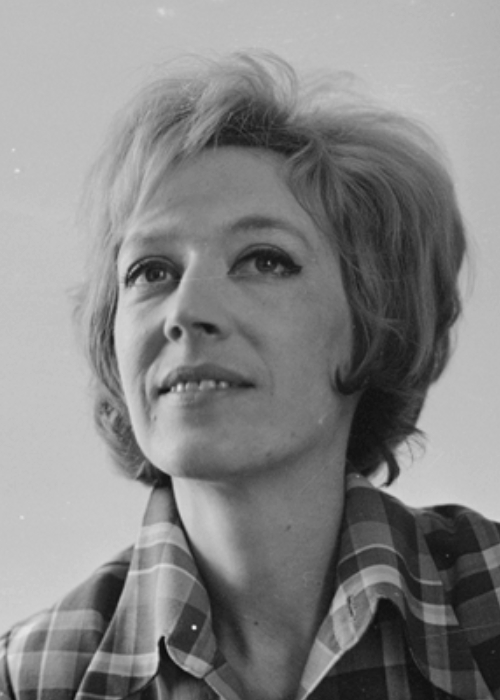
National Digital Archives, Grażyna Rutowska's Archive, sig. 18/19
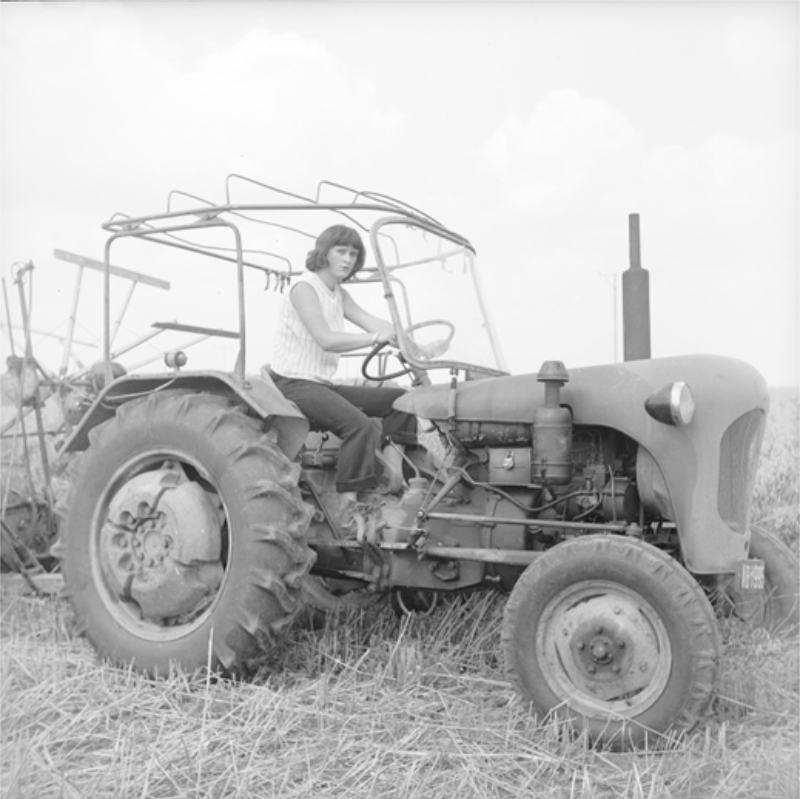
National Digital Archives, Grażyna Rutowska’s Archive, sign. 2/34
Biography
Grażyna Rutowska (1 May 1946 Bytom, Poland – 8 December 2002 Gniezno, Poland) was a press photographer and the author of tens of thousands of pictures depicting everyday life in the Polish People’s Republic, especially in the 1960s and 1970s. Most of her work focused on women of various professions and ages, as well as city and village residents.
Social background and personal life
Grażyna Rutowska’s father, Tadeusz, was a mining engineer. When Grażyna Rutowska turned six years old, her father was appointed deputy director of the State Economic Planning Commission, and later mining director-general. The family then moved to Warsaw. Although her mother, Stanisława Kadulska, held a university degree, she was absorbed in caring for her three children, and decided to return to work only when the family’s financial situation began to require it due to her husband’s illness. No information about her mother’s profession has been found. Grażyna had two siblings, an older sister and a younger brother, with whom she was very close. Grażyna Rutowska never started a family of her own.
Educational and professional path
In addition to attending the Narcyza Żmichowska High School in Warsaw, Rutowska studied at the Moniuszko Music School, learning to play the accordion and then the piano. Her artistic interests also led her to attend photography classes at the local {glossary:Youth House (Pałac Młodzieży)} and assist at {glossary:Witold Dederko}’s photography studio.
After passing her high school exams in 1964, she hoped to study at the Film School in Łódź, but failed the entrance tests. She next applied to study art history at the University of Warsaw but was not accepted due to a lack of places. Finally (and probably inspired by her sister, who had already completed her studies in history) she made the decision to enrol in the Institute of History at the University of Warsaw. However, partly due to her father’s illness, she gave up her studies in 1967, and began her professional career, photographing for various editorial offices.
Over a period of twenty years from 1968 onwards, Rutowska collaborated with the publishing house of the {glossary:United People’s Party (Zjednoczone Stronnictwo Ludowe)}. She worked for the magazines {glossary:Dziennik Ludowy (People’s Daily)} and {glossary:Zielony Sztandar (The Green Banner)}. In 1982, she completed her extramural studies in journalism at the Faculty of Journalism and Political Science of the University of Warsaw. After resigning from the editorial offices of the aforementioned titles in 1988, she pursued a career as a photojournalist for a variety of other periodicals.
In 1993, Rutowska’s encountered severe financial hardship. In her short autobiography, she attributes the situation to the condition of the press market during the political transformation in Poland. Low earnings and a lack of permanent employment forced her to sell her beloved Fiat 125p, as well as her photographic equipment. As a result, she stopped working as a photojournalist and instead completed a course in foreign trade accounting, which she hoped would secure her permanent employment. Unfortunately, because of her inexperience in accounting, no one offered her a job.
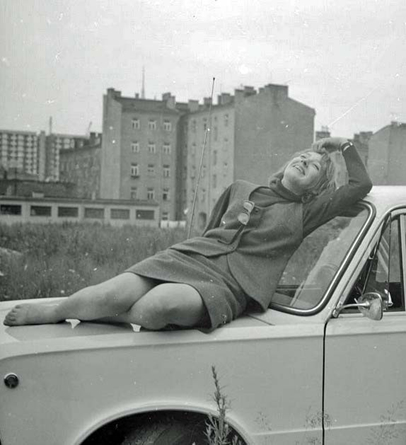
Grażyna Rutowska poses lying on her beloved Fiat 125p car. Warsaw 1971. National Digital Archives, Grażyna Rutowska’s Archive, sign. 18/22
Around 1998, Grażyna Rutowska moved to Gniezno, probably due to a conflict between her and her relatives. During the last years of her life, her health declined, coinciding with a noticeable deepening of her religious devotion. She collaborated with the Catholic press, publishing articles and photographs. She also pursued a new passion: creating devotional objects including bas-reliefs in clay, as well as painting and drawing.
Expert work and activism
During the state-socialist period, Grażyna Rutowska was a member of several youth, professional, and political organizations, including the Polish Scouting and Guiding Association, the Association of Polish Journalists, and the {glossary:United People’s Party (Zjednoczone Stronnictwo Ludowe)}, but was not very engaged as an activist. She focused primarily on her work and developing her hobby of photography. Although she belonged to the Polish Motor Association owing to her passion for motor vehicles, Rutowska travelled abroad only seldom, and did not maintain contact with the international community of photographers.
Research and activism with an emphasis on feminist knowledge
Grażyna Rutowska’s photographic works offer a cross-sectional view of women’s social position in socialist Poland. Thanks to her many years of experience as a photojournalist, Rutowska was able to capture images of women from different social classes, professions and regions of Poland, as well as from urban and rural environments. Her photographs still provide an important illustration of the roles assumed by women in Poland.
Her photographs mirror the changes that took place—particularly in the 1960s and 1970s— with respect to the place of women in society, including women’s employment. The end of the Stalinist period meant restricted access to jobs in professions traditionally considered masculine. Women were also dismissed from managerial positions. In Rutowska’s photographs, we see women working in occupations stereotypically coded as feminine, such as secretaries, nurses, and shop assistants. However, she also photographed female scientists, artists, and politicians. While parenting and housekeeping were predominantly viewed as women’s responsibilities in Polish society, Rutowska’s photographs portray numerous double-burdened mothers, thereby contextualizing their struggles within broader social and political dynamics. Besides this, Rutowska photographed various activities of women’s organizations, such as cooking and sewing courses; and also, less typically for the period, chess meetings for women. We can also find profiles of individual activists in her collections.
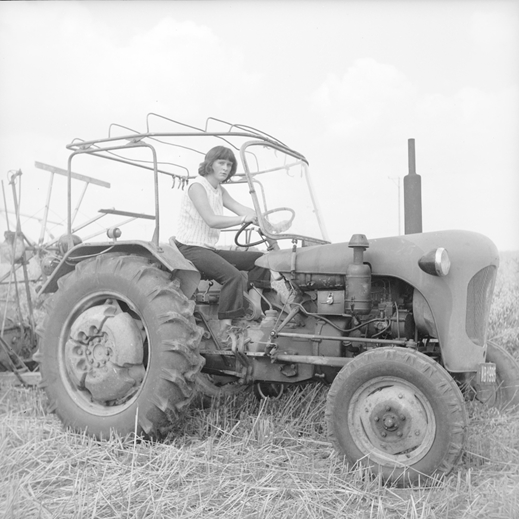
National Digital Archives, Grażyna Rutowska’s Archive, sign. 2/34
Rutowska’s work for the rural press meant that peasant women appeared in many of her works. In particular, she portrayed representatives of the younger generation of rural women as professional farmers (running farms independently or jointly with their husbands) and as modern housewives. Rutowska’s photographs also feature women participating in courses organized by the Rural Youth Association and the {glossary:Rural Housewives’ Circles (Koła Gospodyń Wiejskich)}. She was keen to show women operating modern agricultural machinery or driving tractors, returning, in a sense, to the slogans advertising young females performing ‘male’ jobs promoted in the 1950s.
Consistent with the conventions of her profession, Rutowska rarely appears in her own photographs. However, when she does, she presents herself as a modern, well-groomed woman with a fashionable blonde bouffant hairstyle. Rutowska consciously created this image. Every year, she took self-portraits in the mirror, showing herself as an active woman, pursuing her passions and taking pride in a profession still dominated by men. Rutowska also took nude self-portraits, which would have provoked moral outrage had they been made public at the time. Uniquely, she donated her nude photographs in 1998, along with the rest of her legacy, to the {glossary:National Digital Archives (Narodowe Archiwum Cyfrowe)}, where they were to be made available to the public.
The images of women depicted in the photographs taken by Rutowska reflect prevailing trends in thinking about the role and position of women in socialist Poland, but at the same time Rutowska also offers her own interpretations in her decision to photograph female tractor drivers at a moment when they no longer featured prominently in official discourse.
Legacy and impact
Grażyna Rutowska was one of the few women photojournalists in the Polish People’s Republic. In total, she took nearly 40,000 photographs. They depict architecture, industry, agriculture, trade, services, transport, science, culture, leisure, and everyday life in over 500 locations throughout the country. Many of Rutowska’s photographs feature women whose images were consciously created. These photos were posed, and the locations and subjects were carefully selected to show women who were considered to be worthy role models.
Her press releases contributed to the discourse on the situation and role of women under state socialism in Poland. On the one hand, Rutowska’s photographs depict women during a period when certain emancipation processes with regard to women’s employment had stagnated, and when a return to women’s reproductive and domestic roles was viewed as paramount. On the other hand, Rutowska consciously portrayed independent women as increasingly active in both their professional and social lives. Similarly, she created her own image as a self-reliant, modern, and professionally fulfilled photographer, liberated from social norms.
Karolina Siewak
Selected Works
Narodowe Archiwum Cyfrowe, Archiwum Grażyny Rutowskiej [Grażyna Rutowska Archives].
Bibliography
PRL Grażyny Rutowskiej: fotografie z Narodowego Archiwum Cyfrowego, ed. Łukasz Karolewski, trans. Urszula Rybak (Warsaw: Narodowe Archiwum Cyfrowe; Naczelna Dyrekcja Archiwów Państwowych, 2015).
Łukasz Karolewski, „Społeczne role kobiet z lat 60. i 70. XX w. na fotografiach Grażyny Rutowskiej,” in Educare Necesse est – Kobieta w społeczeństwie od średniowiecza do końca XX w. Przykłady dobrych praktyk edukacyjnych, ed. Violetta Urbaniak (Warszawa: Archiwum Państwowe w Warszawie: Wydawnictwo DiG, 2024), 121–138.
Marcin Rogala, „Obrazy codzienności PRL-u w fotografii Grażyny Rutowskiej,” in PRL-owskie re-sentymenty, ed. Alicja Kisielewska, Magdalena Kostaszuk-Romanowska and Adam Kisielewski (Gdańsk: Wydawnictwo Naukowe Katedra, 2017), 71–84.