Emmi Pikler
1902 - 1984
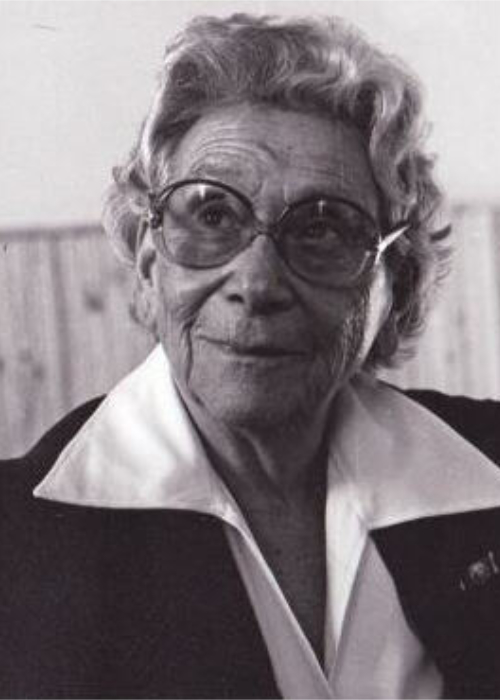
Lucia Vichi, Wikimedia Commons CC BY-SA 4.0
“If a woman has already learned to breastfeed, recovers, and goes home, she will then return to work. But if she goes back to work, she has to leave her infant at home. It is pointless that we have taught her how to breastfeed if, as soon as she starts working, she has to stop breastfeeding again. The issue of workplace nurseries is therefore urgently important, so that a woman who goes to work can take her infant with her and breastfeed there.” (Emmi Pikler’s speech at the Budapest City Council meeting. Fővárosi Közlöny, 19 September 1946)
“Ha a nő már tud szoptatni, meggyógyul és hazamegy, akkor munkába megy. Ha munkába megy, otthon kell hagynia csecsemőjét. Hiába tanítottuk meg szoptatni, ha később, amint elkezd dolgozni, újra abba kell hagynia. Égetően sürgős kérdés tehát az üzemi bölcsődék kérdése, hogy a nő, aki elmegy munkába, elvihesse magával csecsemőjét és ott megszoptathassa.” (Emi Pikler’s speech at the Budapest City Council meeting. Fővárosi Közlöny, 19 September 1946)
Biography
Emmi Pikler (9 January 1902, Vienna, Austria-Hungary [now Austria] – 6 June 1984, Budapest, Hungary) was a pediatrician and infant care specialist. In the post-Second World War period, she was head of the residential infant home on Lóczy Lajos Street, where she developed the Pikler method, which brought her international fame and recognition. Her philosophy centered on the autonomous child, emphasizing minimal adult intervention, opportunities for undisturbed exploration, and independence.
Social background and private life
Pikler was born Emilie Madeleine Reich in the Austro-Hungarian monarchy to a religious Jewish family. Her father Heinrich Reich was a carpenter; her mother, Hermine Frankenstein was a kindergarten teacher who died when Emmi was 12. The family moved to Budapest in 1908, where Emmi Pikler completed her primary and secondary education. After the First World War, the borders of the country were drastically redrawn, and amid rising nationalism, the anti-Semitic numerus clausus legislation of 1920 was passed, limiting the number of Jewish and female university students. For the Reich family, it meant that university education was essentially out of reach in Hungary, forcing Emmi Pikler to study in Vienna with the help of Austrian relatives.
She married the mathematician György Péter (originally Pikler) in 1930. The family moved frequently because of her husband’s work: first to Trieste, and later back to Budapest. During this period, she gave birth to their first daughter, Anna, who subsequently became the first “Pikler child”, raised according to the principles of free play and free movement (meaning that her parents did not encourage physical skills before she was able to develop them independently). This approach to child-rearing had grown out of Pikler’s clinical experience and her husband’s pedagogical interests. Of their three children, Anna Pikler (later Tardos) became a child psychologist and worked with her mother at the Lóczy Infant Home.
Education and professional path
Emmi Reich moved to Vienna in 1920, and enrolled in the Faculty of Medicine at the University of Vienna. Among her most influential teachers were the pediatrician and immunologist Clemens von Pirquet, and the surgeon Hans Salzer. At the university, the emphasis was on prevention (prophylaxis) and education for a healthy lifestyle. Pikler learned from her professors that each child must be treated as an independent individual with self-consciousness. She graduated in medicine in 1927.
She occupied several positions after gaining her medical degree, first as an intern at the Bacteriology Department of the Emperor Francis Joseph Hospital (1926–1927), then research associate at the Serum Therapy Institute at the same hospital (1927–1928). In 1929, she became an assistant physician at the Pediatric Clinic of the University of Vienna, before taking up a position at the Mauthner Markhof Children’s Hospital. In 1930, after her husband received a teaching position in a secondary school in Trieste, Pikler worked as an intern at the Pediatric Department of the Regina Elena Municipal Hospital in that city.
Intellectual influences
The intellectual background of Pikler’s work was shaped largely in Vienna. During the interwar period, she encountered Freudian psychology, but later gravitated toward concerns about physical well-being. She was familiar with the reform-minded intellectual circles of Budapest, and developed a lifelong collaboration with photographer Marian Reismann, who became well known for her innovative child-photography techniques. The clientele of her private practice also came from assimilated Jewish and urban left-wing circles. Interwar German specialists in holistic body culture likewise influenced the development of Pikler’s method. The Berlin-based gymnastics teacher Elfriede Hengstenberg taught summer courses in Budapest between 1935 and 1938 at Pikler’s invitation.
Expert work and activism
After moving to Budapest in 1932, her husband gave up teaching and took a position in the private sector while joining the illegal Communist Party. Pikler herself lived a comfortable middle-class life in Buda, teaching occasionally at Tante Biri’s German kindergarten. In 1936, her husband became the subject of an anti-Communist show trial and was arrested, forcing Pikler to open a private pediatric practice.
Amid the persecution of the Jewish people in Hungary, Pikler continued to work as a private pediatrician and teacher. Her first book, What Does the Baby Already Know?, was published in 1940. In this early account of what later became the Pikler method, she offered practical child-rearing advice to mothers, with particular emphasis on free movement and infant autonomy. Between 1940 and 1944, together with the pedagogue Jenny Halász, Pikler held a childcare training seminar for young Jewish women who could not enroll in higher education because of anti-Semitic laws. Acting as a nanny for her former clients, an upper-middle-class Christian couple. Pikler was able to survive the Holocaust in Budapest under false papers.
After the war, she helped organize nurse-training programs in the Szeged region in the southeast of Hungary before returning to Budapest in 1945, together with her released husband, to rejoin the communist movement. She was appointed head of the Mátyás Rákosi Children’s Home on Kmetty Street, a crèche and kindergarten for the party elite. As a communist party delegate and an expert, Pikler became a member of Budapest City Council. She also served on the healthcare board of the {glossary:Women’s Council}. From 1946 onwards, she served as director of the newly-established residential children’s home on Lóczy Lajos Street. Known simply as “the Lóczy,” the institution subsequently developed into an official state methodological center for residential childcare during the state socialist period. This period was not without controversy, however, as children of parents facing show trials, imprisonment or execution were transferred by the Communist Party to the Lóczy, often against the will of their families.
In addition to refining infant care and residential child-rearing practices, Pikler also developed training methods for nurses in early childcare institutions. In 1971, the institute was renamed the National Methodological Centre for Infant Homes, marking the growing prestige of Pikler’s work in state socialist Hungary.
Emmi Pikler published several books on child-rearing. Her second book, In Socialism there is no Orphaned Child (1950), presented the Lóczy institute and its distinctive methods of respectful care. In the 1950s, two comprehensive methodological guides were published by Pikler and her colleague, Magda László: one for childcare professionals, Textbook for Infant and Child Care Nurses (1953), and one for mothers, The Mothers’ Book (1954). These works emphasized the importance of a stable environment, consistent caregivers, and predictable daily routines for infants. Both books were reissued several times and translated into multiple languages. In 1968, Pikler received the title of Candidate of Sciences (C.Sc., equivalent to a Ph.D) for her work on the Lóczy method.
International engagement and networks
Pikler’s methods were aimed at local audiences and developed through a transnational exchange of ideas. In 1952, as part of the Hungarian delegation, Pikler traveled to Vienna for the International Child Protection Conference. In 1966, she presented her study on infant development at the XVIII. International Psychology Conference in Moscow. In the same year, she participated at the First International Symposium on Nunneries in Prague. Following this conference, the World Health Organization funded the first large-scale study of the Lóczy children, concluding that none of the children in Pikler’s residential care displayed long-term consequences of hospitalism.
Although the Pikler method is now an internationally recognized approach, its global reputation emerged largely through the work of Pikler’s students. After the {glossary:October Revolution in Hungary (1956)}, her student Magda Gerber emigrated to the United States, where she began teaching and promoting the Pikler method. Similarly, Ágnes Szántó-Féder popularized her method in France. In Hungary, Pikler’s colleague, Judit Falk and her daughter Anna Tardos continued the work of the Lóczy institute and built a transnational network dedicated to the Pikler approach.
Research and activism with an emphasis on feminist knowledge
Pikler’s primary expertise focused on children rather than women’s rights. Even so, her work intersected with gendered structures of care. During the interwar period she aimed to raise independent babies in order to ease the burden on mothers. Her practice-oriented ideas were first tested in private homes, where mothers were asked to keep baby diaries documenting their child’s development. However, most of her clients were middle-class urban families of Jewish background, which conflicted with her communist commitments. In her books, Pikler promoted a professionalized vision of motherhood and infant care, guided by medical expertise.
By the end of the war, the situation had changed drastically, and it was orphaned children who now needed institutional care. Pikler sought to adapt her home-care model to the context of residential institutions. One of her central challenges was preventing hospitalism (signs of emotional neglect of children in institutions) among infants raised in state care. At the Lóczy, she developed a new model of infant development and reformed the training of infant nurses. This professionalization had an implicit gender dimension: it created opportunities for women’s employment while reframing care labor as trained work. Pikler also advocated for nurseries that enabled mothers’ employment, situating her work within broader debates on gender and labour. To prevent hospitalism, infants had designated nurses who provided personalized care. In state care, the Pikler nursing method encouraged bonds between infants and their nurses, but this emotional bond in her opinion, cannot replace maternal love. Early in her career, Pikler was criticized by contemporaries associated with family-based care, and later by those concerned with the risks of institutional care: critics of the method have argued that it risked emotional neglect in favor of prioritizing physical development.
Legacy and impact
Emmi Pikler led the Lóczy until 1978 and remained active until her death in 1984. The Pikler method remains a respected and widely applied approach to infant care and childrearing. Its influence extends across multiple countries and continues to shape both professional caregiving practices and parenting philosophies. In 2012, the NGO ‘Pikler International’ was founded to bring together the global network of practitioners and institutions committed to preserving and developing her childrearing methods. Today, national and local Pikler associations operate in the United States, Portugal, Argentina, Spain, Italy, France, Germany, Austria, Switzerland, and the Netherlands. Public spaces named after Emmi Pikler can be found in Paris and Budapest. At the same time, reception of the Pikler method varies: while her work is generally viewed positively abroad, in Hungary it has generated ongoing debate and criticism, and the method remains controversial. The Hungarian Pikler Society continues to operate, maintaining her intellectual and methodological heritage.
Fanni Svégel
Selected Works
Pikler, Emmi. Mit tud már a baba? [What Does the Baby Already Know?] Budapest: Hungária Könyvkiadó, 1940. (In French: 1948, in Slovak 1948; in German: 1982)
Pikler, Emmi. A szocializmusban nincsen árva gyermek. [In Socialism there is no Orphaned Child] Budapest: Egészségügyi Könyvkiadó, 1950.
Pikler, Emmi, Magda László and Imre Hirschler. (eds.) Anyák könyve. [Mothers’ book] Budapest: Egészségügyi Könyvkiadó, 1954.
Pikler, Emmi. Adatok a csecsemőmozgásának fejlődéséről. [Data on the Development of Infant Movement] (C.Sc. Dissertation) Budapest: Akadémiai Kiadó, 1969. (In French: 1979; in Italian: 1980, in Spanish: 1985, in German: 1988)
Bibliography
Czimmek, Anna. Emmi Pikler: Mehr als eine Kinderärztin [Emmi Pikler: More than just a paediatrician]. Munich: P. Zeitler Verlag, 2015.
David, Myriam, and Geneviève Appell. Lóczy ou le maternage insolite [Lóczy or unusual mothering]. Paris: Éditions du Scarabée, 1973.
Kozák, Péter. “Pikler Emmi.” In Nők a magyar tudományban [Women in Hungarian Science], edited by Margit Balogh and Mária Palasik. Budapest: Napvilág, 2010: 548-549.
Svégel, Fanni. “Anyaság és gyereknevelés a professzionalizáció és a politika szorításában: Pikler Emmi munkássága.” [Motherhood and child-rearing in the grip of professionalization and politics: the work of Emmi Pikler] Opuscula Theologica et Scientifica 3, no. 1 (2025): 231–260.
Varsa, Eszter. Protected Children, Regulated Mothers: Gender and the “Gypsy Question” in State Care in Postwar Hungary, 1949–1956. Budapest: CEU Press, 2021.
Austria | Austria-Hungary | child protection | childcare | health | Hungary | motherhood