Barbara Tryfan
1925 - 2012
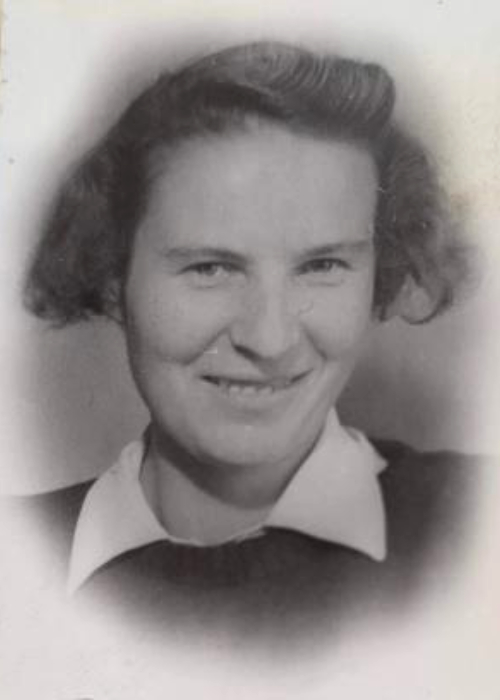
Tryfan in (or before) 1952: Archive of Modern Records, 1827/8589
“The situation of women is very difficult. They are alone in their struggle, because village opinion does not help them overcome traditional ways of thinking. As a result, changes in the position of rural women are taking place, but slowly and not without conflict.”
“Sytuacja kobiety jest bardzo trudna. W swoim zmaganiu jest ona osamotniona, bo opinia wioskowa nie pomaga jej przezwyciężyć tradycyjnych schematów myślenia. Sprawia to, że zmiany w pozycji kobiety wiejskiej dokonują się, ale powoli i nie bezkonfliktowo.”
Quoted in: Barbara Tryfan, Nowe elementy pozycji społecznej kobiety wiejskiej, “Kultura i Społeczeństwo”, 1968, no. 2, p. 134.”
Biography
Barbara Tryfan-Obiedzińska (2 September 1925, Warsaw – 5 May 2012, Warsaw) was a sociologist of rural women in postwar Poland. Her scientific work focused on rural women’s emancipation, as well as the situation of the elderly in agricultural areas.
Family and social background
Barbara Tryfan was born in Warsaw. Her father, Ludwik Tryfan, worked in a railway workshop, and her mother Amelia (née Nowakowska) died when Barbara was eleven years old. After her mother’s death, Barbara had to take care of the household, including her retired father and her younger brother. She studied at the Queen Jadwiga Gymnasium in Warsaw and earned money by giving lessons. After the outbreak of the war, she continued her education, completing her high school diploma in 1944. During the {glossary:Warsaw Uprising}, the Tryfan family’s house burned down. Barbara settled first in Częstochowa, and later, after liberation by the Red Army, moved to the village of Zuzin in western Poland, where she worked as a village teacher.
Educational and professional path
After returning to Warsaw, she began her studies in Romance philology at the University of Warsaw. As a student, she stood out for her ambition and commitment, as evidenced by her high grades and the flattering opinions of her professors. She received a doctoral scholarship from the French Institute in Warsaw, but did not take advantage of the opportunity to go to Paris due to her father’s illness. After graduating, Tryfan began working as a journalist. From 1949 to 1965 she worked in the editorial department of the youth magazine {glossary:Nowa Wieś (New Village)} where she covered socio-cultural changes in the countryside. She also published articles and reports in the well-known scholarly journals {glossary:Wieś Współczesa (Contemporary Village)} and {glossary:Kultura i Społeczeństwo (Culture and Society)}, mainly concerning the transformation and civilizational development of rural areas.
In 1968, she defended her doctoral thesis entitled “The social position of rural women in the family and environment. A research study on the example of the industrialized region of Plock” at {glossary:Warsaw University of Life Sciences} (SGGW). From September 1965, she worked at the Department of Industrialized Regions of the Polish Academy of Sciences (from 1971, the Institute of Rural and Agricultural Development – IRWiR PAN), where she served as head of the Department of Rural Sociology from 1972. She earned her habilitation degree in 1971 at SGGW with a thesis on old age in rural areas. In the same year, she joined the Independent Department of Rural Homesteading at SGGW’s newly established Faculty of Human Nutrition and Rural Homesteading, of which she became associate dean in 1978. She was awarded the title of associate professor in 1981.
Intellectual influences
The development of Tryfan’s scientific career came at a time when sociology was returning to universities after the Stalinist years, during which it had been considered a bourgeois science. The subject of rural women also began to attract more interest among researchers. Barbara Tryfan was probably persuaded to return to the academy in 1965 by Dyzma Galaj, a rural sociologist at the Polish Academy of Sciences and editor of the magazine Wieś Współczesna, in which Tryfan published her texts on life in the countryside. She was also inspired by another sociologist, Magdalena Sokołowska, author of such works as “Working Woman” and “Modern Woman.” Tryfan drew on the works of Jerzy Piotrowski and Adam Kurzynowski, who addressed the issue of women’s work and family, while her proficiency in French enabled her to refer to the articles of French authors and researchers.
Expert work and activism
Barbara Tryfan was not only an active researcher and publicist, but also a member of many national organizations. She was a former vice-president of the General Council of {glossary:Rural Housewives’ Circles (Koła Gospodyń Wiejskich)}. She also taught courses for the women activists of the Polish Peasant Party (ZSL) and for the young girls of the {glossary:Rural Youth Association (Związek Młodzieży Wiejskiej)} (ZMW). Combining her career as an academic, journalist and organizer allowed Tryfan to pursue the main goal of her activism: equal rights for the rural population, and improved living standards for rural women. She co-authored many reports and proposals for change, including those of a legal nature, to improve the social situation of rural women. For example, she called for the expansion of the network of perinatal clinics, and raised the issue of social benefits and labor protection entitlements for women working on individual farms, to bring them into line with the rights provided for those women working on collectivised farms.
International engagement and networks
Tryfan was an internationally active expert, not least because of her fluency in French and English. She participated in the World Congress of Sociology, the Food and Agriculture Organization (FAO), and the {glossary:International Federation for Home Economics (IFHE)}. In addition, she received various foreign scholarships. In 1962, thanks to a scholarship from the Ministry of Culture and Education, she was able to travel to Denmark, Sweden and Novgorod, where she examined problems related to out-of-school educational institutions in agricultural areas and assessed the cultural level of rural people. In 1969-1970, she undertook an internship in France at the invitation of the Sorbonne University and the Agronomic Research Institute in Paris. She conducted research on a comparative study of the situation of women in agriculture in different regions of France. In 1973, she went on an exchange between the American Academy of Sciences and the Polish Academy of Sciences, during which she worked on the issue of guidance on the better management of rural households.
Research and activism with an emphasis on feminist knowledge
Barbara Tryfan’s scientific and organizational activities were focused on the actual improvement of the living conditions of the rural population, especially women and the elderly. She believed that scientific and educational activities were meaningless if they were not underpinned by concrete objectives, and if they did not aim to put those demands into practice. Tryfan devoted much attention to the problem of transforming the role of rural women in the family and society, and the issue of gender inequality. She paid particular attention to the situation of women whose husbands left to work in the city: on the one hand, they gained greater authority by taking on male responsibilities, including managing the household and representing the family; on the other, they were burdened with additional responsibilities, which limited their independence. She recognized that the biggest obstacles to rural women’s emancipation were backwardness and lack of knowledge. For this reason, Tryfan often emphasized the role of education among rural women and was eager to take part in courses organized by rural women’s organizations. She published texts in magazines and published popular books aimed at rural women, with the aim of motivating them to become more active in social, cultural and political life.
Legacy and impact
By focusing her academic work on the problem of rural women and the elderly in the countryside, Barbara Tryfan not only pursued her research interests, but also made a real impact on improving the lot of these social groups. Her strong conviction of the need for women’s emancipation was reflected in her private life. In her marriage, she was the one dedicated to career advancement, while her husband and hired domestic help took care of the house and children. The scholarly legacy that Tryfan left behind is being continued today by contemporary researchers.
Karolina Siewak
Selected Works
Barbara Tryfan, Dylematy emancypacji [The dilemmas of emancipation] (Warszawa: Instytut Wydawniczy Związków Zawodowych, 1989).
Barbara Tryfan, Pozycja społeczna kobiety wiejskiej: studium badawcze na przykładzie rejonu płockiego [The social position of rural women: a research study based on the example of the Płock region] (Warszawa: Spółdzielnia Wydawniczo-Handlowa “Książka i Wiedza”, 1968).
Barbara Tryfan, Rodzina wiejska [Rural family] (Warszawa: Zakład Wydawnictw CZSR, 1977).
Barbara Tryfan, Rola kobiety wiejskiej [The role of rural woman] (Warszawa: Państwowe Wydawnictwo Rolnicze i Leśne, 1976).
Barbara Tryfan, Sprawy kobiet wiejskich w wybranych krajach [Issues of rural women in selected countries] (Warszawa: Państwowe Wydawnictwo Rolnicze i Leśne, 1981).
Bibliography
Sylwia Michalska, „Kobiety w socjologii wsi: badane i badaczki [Women in Rural Sociology: Subjects and Researchers]” in Waleczny duch kobiety. Społeczno-ekonomiczne aspekty ról kobiecych [The Fighting Spirit of Women. Socio-Economic Aspects of Female Roles], ed. Kinga Lendzion and Olga Kotowska-Wójcik (Warszawa: Wydawnictwo Uniwersytetu Kardynała Stefana Wyszyńskiego, 2015), 167–177.
Barbara Klich-Kluczewska and Katarzyna Stańczak-Wiślicz, „Biographical Experience and Knowledge Production: Women Sociologists and Gender Issues in Communist Poland” in Gender, Generations, and Communism in Central and Eastern Europe and Beyond, ed. Anna Artwińska and Agnieszka Mrozik (New York: Routledge, 2021), 146–165.
journalism | Poland | rural women | sociology | unpaid work | Warsaw