Irena Strzelecka
1920 - 2005
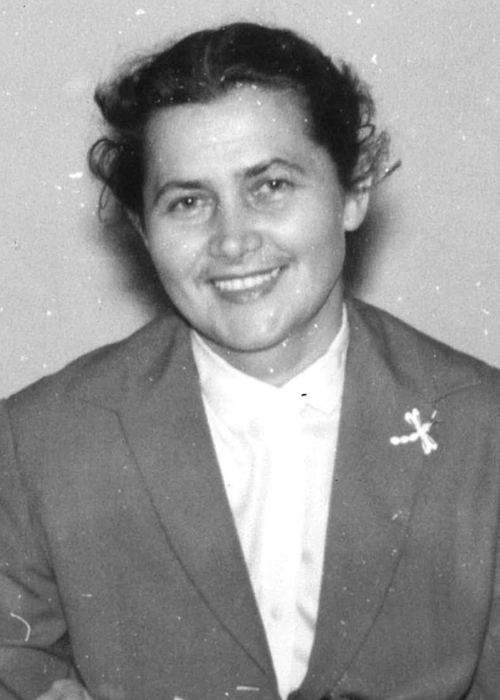
Irena Strzelecka at her desk at Społem Consumer Cooperative office, Warsaw. Source: Muzeum Historii Spółdzielczości, Signature Number: MHS-F-2463, undated.
“We [the National Cooperative Department of the {glossary:League of Women}] are aware that full participation of women in social and professional work is only possible if women are relieved of part of the time and physical effort currently consumed by excessive duties in the household. Therefore, we consider the activities of cooperatives in addressing the difficulties of everyday life to be very insufficient. The development so far of various services that could effectively lighten the workload of housewives, as well as the scope and methods of popularizing modern, progressive approaches to work in the household and on the farm, still do not satisfy us. We are dissatisfied neither with their scope (they do not yet reach the broadest masses of women) nor with the still quite limited range of topics covered. Particularly large shortcomings exist in this area in rural areas.”
“[Krajowy Wydział Spółdzielczy Ligi Kobiet] Zdajemy sobie sprawę z tego, że pełna aktywność kobiet w pracy społecznej I zawodowej jest możliwa tylko wówczas, gdy kobiety uzyskają zwolnienie części czasu I sił fizycznych, pochłanianych obecnie przez nadmiar obowiązków w gospodarstwie rodzinnym. Dlatego też uznajemy za bardzo niedostateczną działalność spółdzielni w zakresie rozwiązywania trudności codziennego życia. Dotychczasowy rozwój różnorodnych usług mogących skutecznie odciążyć gospodynię domową, zakres I sposoby popularyzacji nowoczesnych, postępowych metod pracy w gospodarstwie domowym I zagrodzie- jeszcze nas nie zadowalają. Nie zadowala nas ani ich zasięg (nie docierają one jeszcze do najszerszych mas kobiet), ani dość ograniczone jeszcze pod względem tematyki formy. Szczególnie duże zaniedbania istnieją na tym odcinku na wsi”.
II Krajowy Zjazd Spółdzielczyń, 8-9 czerwiec 1959, Krajowy Wydział Spółdzielczy Ligi Kobiet. Warszawa: Zakład Wydawnictw Spółdzielczych, 1959. [Second National Cooperative Women’s Congress, 8–9 June 1959, National Cooperative Department of League of Women. Warsaw: Cooperative Publishing House, 1959.]
Biography
Irena Strzelecka (1 November 1920, Pruszków – 9 March 2005, Warsaw), was a Polish cooperative and party activist, economist and trade specialist who from 1958 to 1972 served as President of the Board of {glossary:Społem}, the Union of Consumer Cooperatives.
Social background and private life
Irena Strzelecka was born in Pruszków near Warsaw into the large working-class family of Stanisław and Helena Ciesielscy.
In 1946, she married engineer Ryszard Strzelecki, a former comrade from the resistance. Their daughter Krystyna was born in 1947. In 1950, Strzelecki became the Minister of Railways, later serving as Minister of Road and Air Transport, and then as Minister of Communications. In 1961, he was promoted to the Council of State of the Polish People’s Republic, eventually becoming a member of the Political Bureau of the Central Committee of the {glossary:Polish United Workers’ Party (PZPR)} in 1964.
Education and professional path
In 1933, she completed her seven-year primary education, and a year later began attending the Secondary School of Commerce No. 26 in Warsaw, graduating in 1938. On 25 October 1967, she received a master’s degree in economics from the Higher School of Economics in Kraków, Faculty of Domestic Trade.
Strzelecka started working in the cooperative sector when she was just 17 years old, at the Powszechna Consumer Cooperative in Pruszków. From September 1937 to March 1940, she worked there as a bookkeeping assistant, and in March 1940 she was promoted to manager and appointed to the board, positions she held until February 1942.
In February 1942, she became a member of the underground {glossary:Polish Workers’ Party (PPR)} and joined the People’s Guard, which later became the People’s Army (Armia Ludowa). From June 1943, she served as a sergeant in the District Staff, and from March 1944, as a lieutenant and member of the Bureau of the Main Staff of the People’s Army in Warsaw. During the {glossary:Warsaw Uprising}, she fought with the People’s Army, first in the Old Town and later in Śródmieście (the city centre). After the defeat of the Uprising, on 4 October 1944, she was arrested by the Gestapo at the transit camp in Pruszków, but was released two weeks later after being “bought out” by merchants from her home town. In 1945, for her contributions to the resistance movement and her service during the Warsaw Uprising, she was awarded the Silver Cross of the Virtuti Militari, Poland’s most prestigious military decoration.
Expert work and activism
Between 1945 and 1948 Strzelecka held different positions on the Main Board of the Union of Fighting Youth (Związek Walki Młodych) in Łódź, Katowice, and Kraków. In 1949, she joined her husband in Katowice, where he served as First Secretary of the Voivodeship Committee of the PZPR between late 1948 and 1950. Strzelecka herself served as deputy head of the Socio-Political Department of the Voivodeship Office.
In the same year, Strzelecka returned to the consumer cooperative sector, initially as vice-president for trade and production at the Consumer Cooperative in Sosnowiec. When, in 1950, her husband was appointed Minister of Railways, the family moved back to Warsaw and Strzelecka started working at the Warsaw Voivodeship Branch of Społem. In 1951, she was promoted to be vice-president of the Board of Społem, a position she held until 1955. Afterwards, she was transferred to the Ministry of State Control, where she worked first as director of the Trade Department and later as general director. From 1956, she served as deputy minister of that ministry.
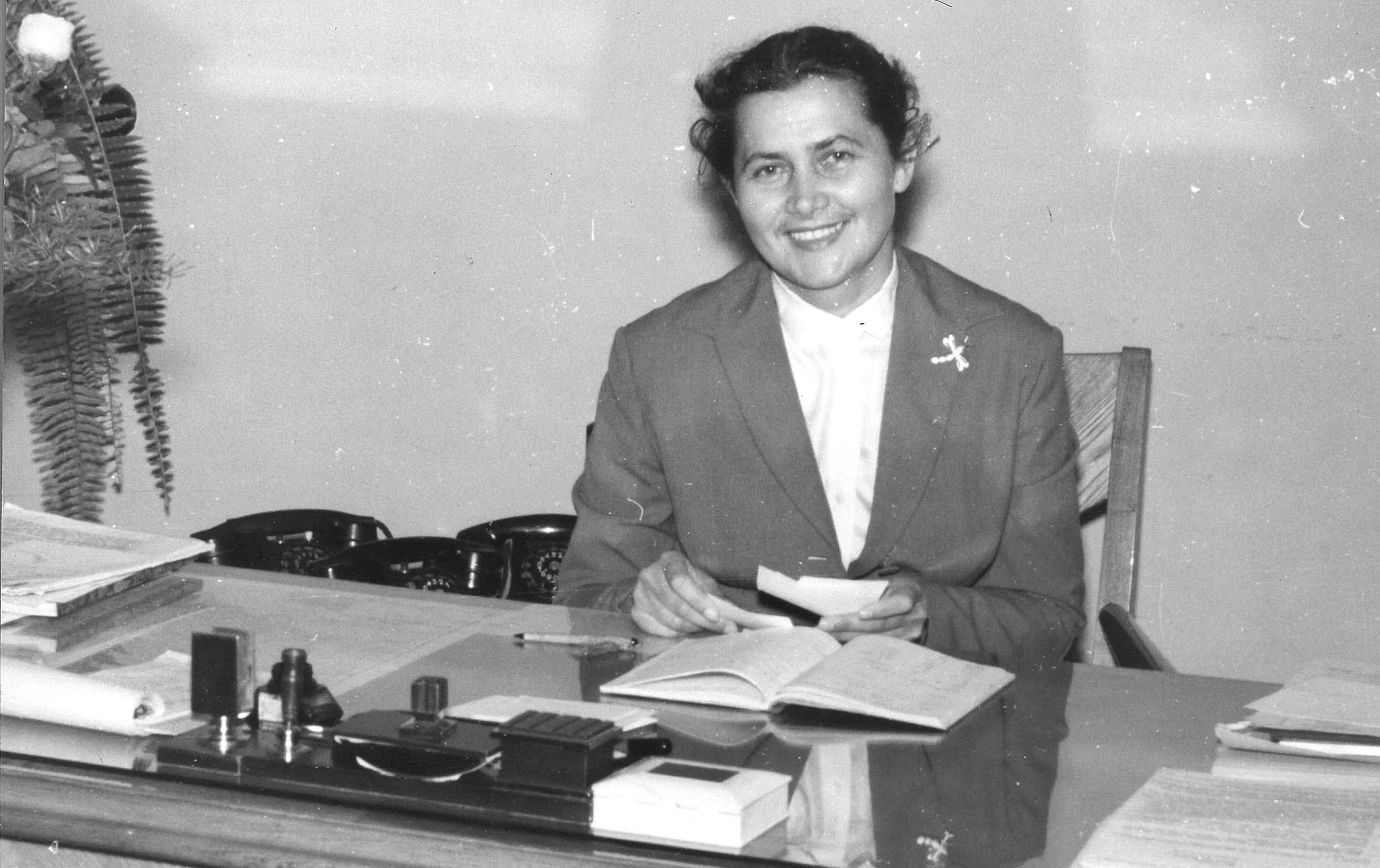
Irena Strzelecka at her desk at Społem Consumer Cooperative office, Warsaw. Source: Muzeum Historii Spółdzielczości, Signature Number: MHS-F-2463, undated.
In February 1958, Strzelecka returned to work at Społem again, this time as President of the Board. She held this position for 14 years until 1972, when, following the change in leadership of the PZPR from Władysław Gomułka to Edward Gierek in 1970, both Ryszard and Irena were forced into early retirement.
Under her leadership, smaller customer cooperatives were merged and reorganized into large and well-resourced cooperative enterprises. She aimed to modernize the retail network of Społem cooperatives by introducing innovations including the construction of new facilities, and the first self-service shops. She oversaw the building of Cooperative Department Stores (Spółdzielcze Domy Handlowe) in several major cities, including Łódź, Warsaw, and Katowice.
Strzelecka dedicated much of her professional life to advancing women’s rights and equal opportunities in the cooperative sector. She was an important figure of the women’s cooperative movement in state socialist Poland. In 1959, as director of the Cooperative Department of the League of Women, she was one of the main organizers of the Second {glossary:National Congress of Women Cooperators} in Warsaw. She also played a leading role in 1963 as Chair of the National Department of Women Cooperators for the Third National Congress. These national congresses gathered hundreds of women from both rural and urban settings, and from different cooperative sectors and levels of organization. Their discussions revolved around recurring questions: how to engage women more fully in the cooperative sector to achieve equality with men in organizational and leadership roles, and how the cooperative movement could help address gendered challenges of women’s everyday lives.
As the director of Społem, Strzelecka promoted the use of the cooperative sector to benefit women on a broad scale. In the early 1960s, she introduced Practical Lady Centers (Ośrodki Praktyczna Pani), run by the Społem Consumer Cooperatives in cities across Poland. The first opened in Warsaw, and by the 1970s there were over 600 such centers. They offered services and educational programs addressing market shortages, including tailoring, hairdressing and corsetry, as well as appliance and furniture rental, and repairs of radios and TVs. Courses covered dressmaking, sewing, knitting, gardening, dance, nutrition, health care, and use of appliances. For men, Ośrodki Praktyczny Pan (Practical Gentleman Centers), although much less common, offered workshops in mechanics and woodworking, technical literature rental, and courses in life skills such as cooking, laundry, and childcare. These initiatives reflected a progressive gendered approach for the period, as they sought both to professionalize traditionally feminized skills and to encourage men’s participation in domestic labour.
International engagement and networks
As part of her work at the National Congress of Women Cooperators in Warsaw, Strzelecka was active in international networks of female cooperative activists. As part of the International Cooperative Alliance —the biggest organization of the international cooperative movement — and its Women’s Consultative Council, the National Congresses served to strengthen the international dimensions of women. s cooperative networks. Each national congress hosted many international women cooperative activists representing their national institutions, mainly from such as the USSR, Czechoslovakia, the German Democratic Republic and Hungary, but also from non-socialist countries such as India and the United Kingdom.
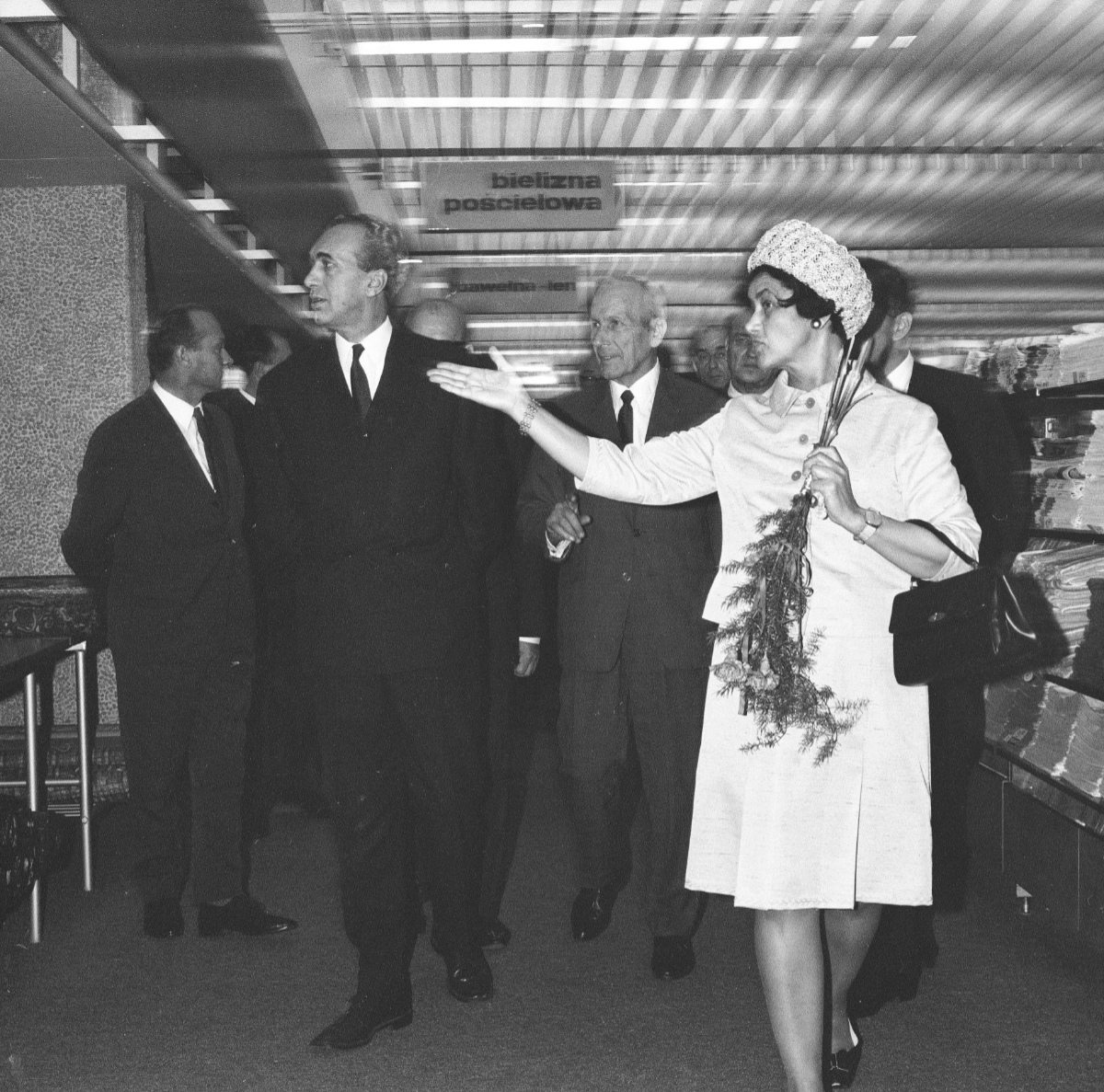
Irena Strzelecka at the opening of the Sezam Cooperative Department Store of the Warsaw Consumer Cooperative Społem at the intersection of Marszałkowska Street and Świętokrzyska Street in Warsaw in 1969. Picture taken by Grażyna Rutkowska. Source: National Digital Archive, Signature Number: 3/40/0/4/238.
Research and activism with an emphasis on feminist knowledge
Strzelecka also worked to promote women’s equal opportunities within the cooperative movement. In 1970, together with economist Hanna Kozłowska, she co-authored Problemy Kobiet Szefów (Problems of Women Managers), a study analysing the position of women in the consumer cooperative sector and examining the conditions for their social and professional advancement, with the explicit goal of increasing female representation in executive roles. The book drew on both qualitative and quantitative research. It summarised the ‘Meeting of Women Holding the Highest Managerial Positions in Consumer Cooperatives’, organised by Strzelecka on 24 February 1970, where 83 women serving as presidents and vice-presidents of Voivodeship and county-level cooperatives discussed their gendered experiences as directors. Additionally, it analysed a survey completed by 74 female managers in which respondents were asked about the biggest issues they faced in their work, such as the burden of domestic labour, gender-based discrimination, and difficulties in managing conflicts.
This book highlighted the persistent underrepresentation of women despite their qualifications and strong professional performance. The publication proposed institutional and systemic solutions, including gender quotas and support for training and education, but also reinforced binary gender norms by offering advice to women on how to cultivate ambition and self-confidence, how to better organize household labor, and even how to modify their appearance for professional success.
In her retirement, Strzelecka remained an active cooperative activist. She volunteered in local self-government bodies and in residents’ organizations such as the Historical Committee of the Warsaw Consumer Cooperative, the Membership Committees of the Koszyki and Tokaj Cooperative Department Stores, the Practical Lady Centers in Piastów and Warsaw, the ‘Śródmieście’ Circle of Retirees and Women Cooperators, and the Aid Foundation for Retirees of the Consumer Cooperative in Warsaw.
Legacy and impact
After her death in 2005, Irena Strzelecka was commemorated in 2008 by the Społem Board when the conference hall at their headquarters at Grażyny Street 13/15 in Warsaw was named after her. A memorial plaque was unveiled in which she is recorded as a “Pioneer of Modernity and Progress in Cooperative Trade, distinguished activist of the Społem Cooperative Movement and the Cooperative Movement in Poland”.
Strzelecka’s career demonstrates that even within the constraints of the cooperative sector in state socialist Poland, with its lack of institutional autonomy, meaningful forms of initiative could still develop. Among them were her contributions to modernizing consumer services, expanding women’s participation and providing equal opportunities in the cooperative movement.
DOI: 10.56514/bd.wef.0012
Mart Chmielewski
Selected Works
Spór o rozwój dostaw bezpośrednich. Warszawa : Zakład Wydawnictw Centrali Rolniczej Spółdzielni, 1967. [The Dispute over the Development of Direct Supply Systems. Warsaw: Publishing Department of the Central Agricultural Cooperative, 1967.]
Węzłowe problemy spółdzielczości spożywców : referat na konferencję naukową “Społem” ZSS i SIB z okazji 100-lecia spółdzielczości spożywców na ziemiach polskich. Warszawa: Spółdzielczy Instytut Badawczy, 1969. [Key Problems of Consumer Cooperatives: A Paper Presented at the Scientific Conference of “Społem” ZSS and SIB on the Occasion of the 100th Anniversary of Consumer Cooperatives in the Polish Lands. Warsaw: Cooperative Research Institute, 1969.]
Spółdzielcza własność w handlu socjalistycznym: problemy teorii i praktyki. Warszawa: Zakład Wydawnictw CRS, 1969. [Cooperative Ownership in Socialist Trade: Problems of Theory and Practice. Warsaw: Publishing Department of the Central Agricultural Cooperative, 1969.]
Problemy kobiet szefów ed. Hanna Kozłowska, Irena Strzelecka. Warszawa: Zakład Wydawnictw CRS, 1970. [Problems of Women Managers. Edited by Hanna Kozłowska and Irena Strzelecka. Warsaw: Publishing Department CRS, 1970.]
Dzieje Warszawskiej Spółdzielni Spożywców Śródmieście, eds. Władysław Jakubowski, Irena Strzelecka. Warszawa: “Społem”, 1988. [The History of the Warsaw Consumer Cooperative “Śródmieście”. Edited by Władysław Jakubowski and Irena Strzelecka. Warsaw: “Społem,” 1988.]