Mária László
1909 - 1989
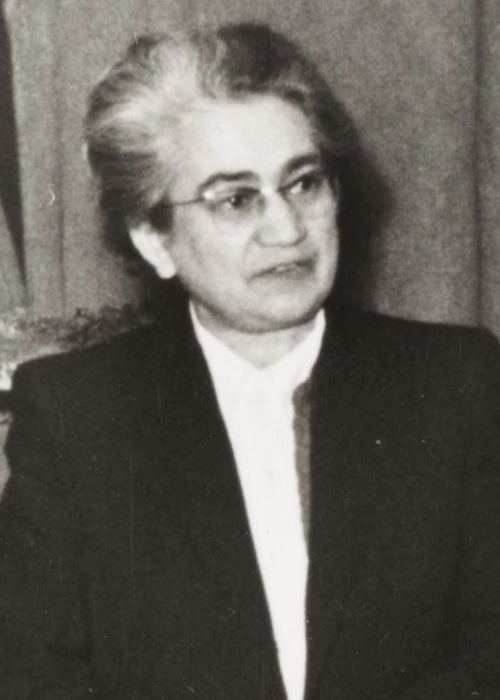
Detail from photograph NM EA SZK 50, 6. Museum of Ethnography (Néprajzi Múzeum), Budapest, Hungary. Full version below.
“It would be of great help if after checking on Gypsy settlements, state organizations could assist with solving the problem of drinking water. This is a primary and indispensable need [to ensure a higher level of culture among Roma]. [State organizations could also help with] w]ork opportunities, house plots, and engagement with [the Roma].”
Hatalmas segítséget jelentene, ha a cigánytelepeket felülvizsgálva az ivóvíz megoldásában segítenének. Első és elengedhetetlen szükséglet a kultúra bevitelére. Munkaalkalom, házhely, és velük való foglalkozás.
Mária László, untitled report about the situation of Roma, n.d., NM MK 7114, Museum of Ethnography (Néprajzi Múzeum), Budapest, Hungary.
Biography
Mária Raffael László (17 November 1909, Nagykáta, Austria-Hungary – 7 November 1989, Budapest, Hungary) was the first secretary-general of the Cultural Association of Gypsies in Hungary (Magyarországi Cigányok Kulturális Szövetsége, MCKSZ), the first nationwide organisation for Roma in Hungary, established on 26 October 1957.
Social background and private life
Born to a Romanes- and Hungarian-speaking Romani family in rural Hungary, Mária László grew up in a family of thirteen children near Nagykáta, a village 65 kilometres from the capital city, Budapest. The divergence of her life’s path from that of most Roma saw her rise to an unprecedented position of leadership for a Romani woman in 1950s Hungary.
While most Roma lived in segregated settlements and did not possess any land, László’s family owned a house and a small piece of land (the size of which, however, did not allow them to survive without additional wage labour). Her father, Farkas László (1874–1954) born Farkas Rafael, was a horse trader. According to a family legend, Mária László’s mother Rozália Czinka Kolompár (1880–1954) was a descendant of one of the most famous Hungarian Gypsy musicians of the 18th century. Unlike poorer peasants (both Roma and non-Roma) who had limited access to basic education in Hungary in the first half of the 20th century, her parents were able to provide for the education of their six children who survived into adulthood.
While there are abundant documents concerning László’s activism, and her work during the brief period when she served as secretary-general of the MCKSZ, much less is known about her activist history in interwar Hungary and generally about her personal life. Her partnership with the daughter of a well-known Romani musician, Ilona Pécsi, remains unaddressed in existing scholarship, or else is referred to in terms of a ‘family relationship’.
Education and professional path
László attended the state primary school at Nagykáta and then a prestigious eight-year secondary school (gymnasium) for girls in Budapest, where she completed grade five in 1928. In the 1930s, she worked briefly as a postal employee in Érd, a small town in Pest County close to Budapest, and as a journalist for a regional weekly paper. She also directed theatre plays. The tone of her articles, some of which she authored under the pseudonym of Mária Ivánka, was influenced by the Hungarian nationalism of the era.
Available primary and secondary sources provide contradictory information about her engagements in interwar Hungary. Some of her biographies mention that when she attended university in the 1940s, she participated in an organization for women students that supported poor families in the countryside. A file of the state security services suggests that she might have joined a right-wing youth association, the Volunteer Labour Service of University and College Students (Egyetemi és Főiskolai Hallgatók Önkéntes Munkaszolgálata), where she served as an organizer and propagandist. In consequence, László was placed under state security surveillance in 1946. Her file was only discarded in 1977. It seems unlikely that she joined the Hungarian Social Democratic Party either before or after World War II, where, as some of her biographers have claimed, she rose to the board of leadership of the party’s Budapest section, exchanging letters with Hungary’s leading woman labour activist and first social democratic woman MP, Anna Kéthly (1889–1976).
According to an interview-based newspaper article from 1958, Mária László first rebelled against injustice in 1937 when she called on the Roma of Pánd to get organized. Pánd was thirteen kilometres from Mária László’s home village in Pest County, where the persecution of Roma increased in the 1930s as a result both of national legislation on expulsions and regular raids, and of local, violently antisemitic and anti-Roma racist ideologies and policy practices. The article claims she was arrested as a suspected communist for incitement and put under surveillance by the gendarmerie for several years. László may indeed have worked in Pánd and assisted local residents as member of the volunteer labour service and this might have served as the basis for later recollections; it seems, however, unlikely that she organized among Roma as a socialist or communist activist.
In state socialist Hungary, similar to other Romani activists in Eastern Europe, Mária László drew on the institutional and ideological frameworks associated with the imagined trajectories of Roma and women’s emancipation to formulate her own agendas. She was the first person in postwar Hungary officially to raise the issue of the persecution of Roma during the Holocaust, and—as secretary general of the MCKSZ—to promote the compensation and rehabilitation of Romani victims. On the very day of the establishment of the MCKSZ, she filed an application for the compensation of Romani victims.
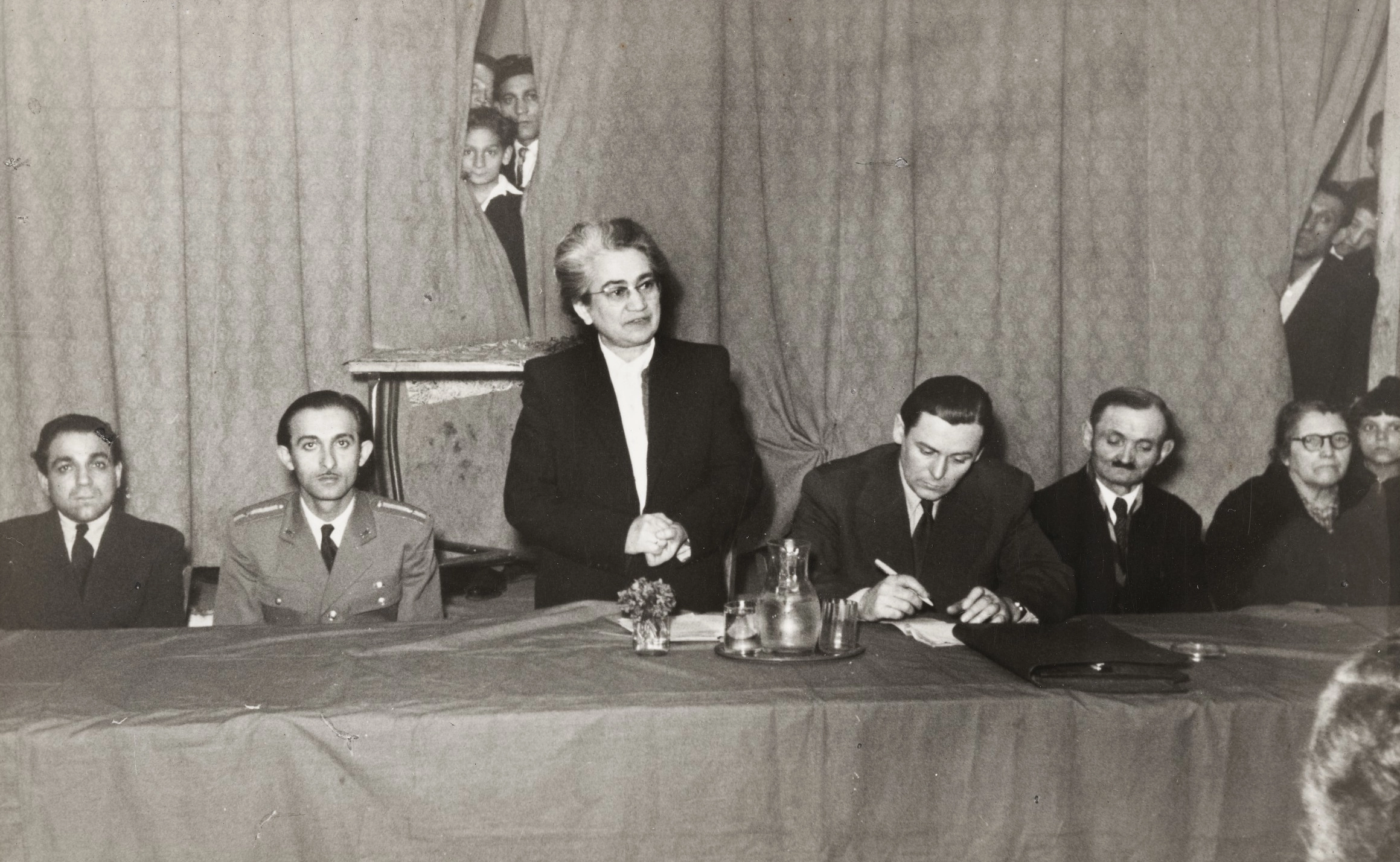
Mária László, Secretary General of the Cultural Association of Gypsies (Magyarországi Cigányok Kulturális Szövetsége), giving a speech. Source and acknowledgements: Photograph, NM EA SZK 50, 6. Museum of Ethnography (Néprajzi Múzeum), Budapest, Hungary.
The MCKSZ was established as part of the Department for National Minorities at the Hungarian Ministry of Culture at a time when a shift was already taking place in the official approach to the “solution to Gypsy Question” in state socialist Hungary. In the mid-1950s some leniency had been shown towards the preservation of Romani cultural heritage in the process of their assimilation. But by the time of the issuance of the first party decree on “the tasks related to the improvement of the situation of the Gypsy population” in 1961, when the association was finally dissolved, Roma were defined as a “backward” social stratum and not a national minority.
A major part of Mária László’s undertakings at the MCKSZ was securing employment opportunities for, and improving the material conditions of, Romani men and women, as well as fighting against racial discrimination. She cooperated with ministries, party and council representatives and mass organizations, such as the Hungarian Ministry of Labour, the National Council of Trade Unions (Szakszervezetek Országos Tanácsa, SZOT), and the National Trade Union of Craft Workers (Kisiparosok Országos Szakszervezete, KISOSZ) the {glossary:National Council of Hungarian Women (MNOT)} and the Hungarian Red Cross (Magyar Vöröskereszt, MV) to support the social services provided to both Romani men and women. As a result of these efforts, by early 1958, there were fourteen nailsmith workers’ cooperatives with over three thousand active members across Hungary, mostly populated by Romani men and women workers.
Research and activism with an emphasis on feminist knowledge
Building on the state-declared goal of increasing equality between men and women, László integrated issues concerning Roma into the agendas and activities of the MNOT. She worked closely with Romani women activists and sustained their work in local Romani communities as well as their inclusion in local and county council structures and state organizations, such as the MNOT. She created a network of MCKSZ colleagues across the country, many of whom were women. She raised awareness about the situation of Roma among non-Romani activists working with Roma, including the MNOT and the MV. She gave seminars and presentations about “the Gypsy question” to non-Romani council employees and activists in these state organisations. Some of the most central topics she addressed—such as the lack of access to drinking water in the segregated settlements— were clearly gendered, and related to the (reproductive) work and responsibilities for the provision of food, daily hygiene and cleanliness carried out by Romani women in their communities. She highlighted the benefits of social integration and the new regime’s need for committed Romani workers. She also emphasized the opportunity for Romani women to support their families through paid work.
The state-embraced principle of anti-racism and her belief that cross-ethnic solidarity was key to the emancipation of Roma and that anti-racism and racial equality constituted core values of a socialist society enabled László to articulate sharp-toned criticism of racism against Roma in 1950s Hungary. In the course of 1958, when authorities exploited the wave of retaliations following {glossary:the 1956 Revolution} to arrest Roma on the grounds of “work-shyness” (munkakerülés) László addressed numerous complaints from Roma concerning the internment of their family members. One case she went to great lengths to rectify reveals how the racialized connotations of “work-shyness” intersected with sexualized and gendered connotations in the case of Romani women. László contacted both the Chief Prosecutor’s Office and the Ministry of Justice to clarify that a nineteen-year-old Romani woman, whom the police arrested and interned “for leading an immoral life,” was “looking after her sick mother and elder sister and took care of the household,” which is why “she could not provide a certificate of employment.” The racialized connotations of “work-shyness” went back to a preconception, born in the nineteenth century, about the lack of willingness of the so-called “wandering Gypsies” to take up productive labour. The sexualised and gendered implications of “publicly dangerous work-shyness” revealed the assumption police had about the “inclination” of Romani women to prostitution.
In late 1958, Mária László was forced to leave the MCKSZ in consequence of changing politics toward Roma, as well as the criticism she had directed towards the authorities. Her subsequent efforts to secure herself a job in a field of work related to Roma failed. In the 1960s, she was employed at an engineering and construction works state company.
Legacy and impact
Mária László died on 7 November 1989 in Budapest. Her life and work set an example for many later Roma rights activists and made her an acknowledged figure of the Roma civil rights movement in Hungary. Most recently, on the initiative of Ágnes Daróczi (1954 – ), a leading Romani woman activist in Hungary, a memorial tablet in Budapest was erected to commemorate her work in the field of women’s politics.
DOI: 10.56514/bd.wef.0007
Eszter Varsa and György Majtényi
Selected Works
Mária László, ‘Felirat a Magyar Népköztársaság Minisztertanácsához a Magyarországon élő cigány néptöredék gazdasági, politikai és kulturális életszínvonalának emelése tárgyában’, 9 January 1956, NM SZK 50 3.d.
Bibliography
Bogdán, Péter. ‘“Erre már úgysem kíváncsi senki”: Portré László Máriáról, a magyarországi roma mozgalom első vezéralakjáról [“Nobody is Interested in This Any More”: Portrait about Mária László, the First Leading Figure of the Romani Civil Rights Movement in Hungary]’. Barátság: Kulturális és Közéleti Folyóirat, 15 June 2025.
Çağatay, Selin, Mátyás Erdelyi, Alexandra Ghit, et al. Women’s Labour Activism in Eastern Europe and Beyond: A New Transnational History. Work Around the World: Studies in Global Labour History Series. UCL Press, 2025.
Daróczi, Ágnes. Hosszú az út előttem [There is a Long Road Ahead of Me]. Edited by Angéla Kóczé. Tények és tanúk. Magvető Kiadó, 2023.
Daróczi, Ágnes. ‘Mivé lettünk? Roma kulturális mozgalom az emancipációért [What Have We Become? A Romani Cultural Movement for Emancipation]’. Új Ifjúsági Szemle 4, no. 2 (2006): 51–52.
Kóczé, Angéla. ‘Roma Civil Rights Movement in Hungary’. RomArchive, 2019. https://www.romarchive.eu/en/roma-civil-rights-movement/roma-civil-rights-movement-hungary/.
Kóczé, Angéla. ‘The Building Blocks of the Romani Women’s Movement in Europe’. RomArchive, 2019. https://www.romarchive.eu/en/roma-civil-rights-movement/building-blocks-romani-womens-movement-europe/.
Majtényi, Balázs, and György Majtényi. A Contemporary History of Exclusion: The Roma Issue in Hungary from 1945 to 2015. CEU Press, 2016.
Menyhért, Ildikó. ‘100 éve született László Mária [Mária László was Born a 100 Years Ago]’. Lungo Drom 18, no. 1 (2010): 14–16.
Sághy, Erna. ‘Cigánypolitika Magyarországon, 1945─1961 [Gypsy Politics in Hungary, 1945-1961]’. Regio 10, no. 1 (1999): 16–35.
Sághy, Erna. ‘Cigánypolitika Magyarországon az 1950–1960-as években [Gypsy Politics in Hungary in the 1950s–1960s]’. Múltunk: Politikatörténeti folyóirat 53, no. 1 (2008): 273–308.
Szász, Anna Lujza. ‘Nyilas üldöztetés, államszocialista meghurcolás és polgárjogi mozgalom: egy roma aktivista a 20. században [Arrow Persecution, State Socialist Persecution and the Civil Rights Movement: a Roma Activist in the 20th Century]’. Mérce, 10 January 2021. https://merce.hu/2021/01/10/nyilas-uldoztetes-allamszocialista-meghurcolas-es-polgarjogi-mozgalom-egy-roma-aktivista-a-20-szazadban/.
Varsa, Eszter. ‘““No One has Raised their Voice in Support of the Gypsy, who Works Honestly”: An Intersectional Analysis of Romani Activist Mária László’s Labour Agendas and Repertoires in 1950s Hungary’. Labour History: A Journal of Labour and Social History forthcoming (2026).
Varsa, Eszter, and György Majtényi. ‘Mária László’. In Enzyklopädie Des NS-Völkermordes an Den Sinti Und Roma in Europa, edited by Karola Fings. Forschungsstelle Antiziganismus an der Universität Heidelberg, 6 December 2024. https://encyclopaedia-gsr.eu/lemma/laszlo-maria-en-1-0/.
activism | anti-racism | childcare | employment | housework | Hungary | living conditions | paid/unpaid work | Roma