Zsuzsa Ortutay
1913 - 1982
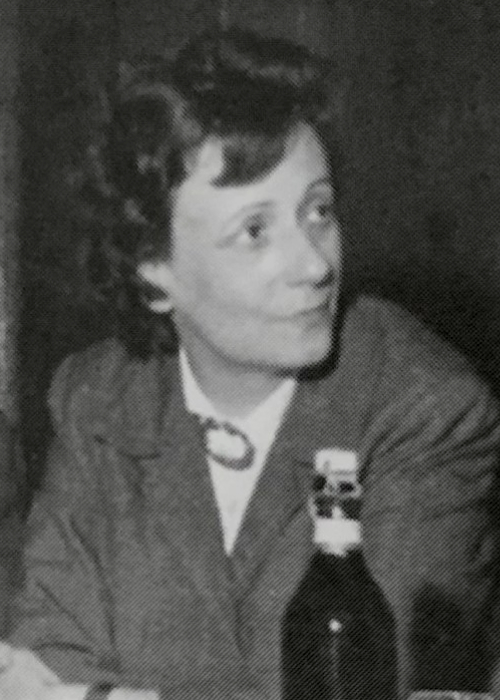
Ortutay, Gyula: Napló 1. 1938-1954 [Diary 1. 1938-1954]. Pécs, Alexandra Kiadó, 2009. Unknown photographer, courtesy of the family.
“Women have equal rights and receive the same pay for their work as men, but their working conditions are not equal. […] This cannot be solved merely by having more washing machines or better factory kitchens. Men must finally recognize that women are carrying far too heavy a burden. Men must also take part in the ‘second shift’.”
“Az asszonyok egyenjogúak és egyenlő bért kapnak a munkájukért a férfiakkal, de munkakörülményeik nem egyenlőek. […] Ezt nem oldja meg csupán a több mosógép vagy a jobb üzemi konyha. A férfiaknak kell végre belátniok, hogy túl sok a teher az asszonyokon. A férfiaknak is részt kell venniök a »második műszakban«.”
Zsuzsa Ortutay’s speech at the Women’s Council meeting. Népszabadság, 14 September 1957
Biography
Zsuzsa Ortutay, née Kemény (13 February 1913, Budapest, Austria-Hungary [now Hungary] – 12 February 1982, Budapest, Hungary) was a Hungarian teacher and family policy expert of the {glossary:National Council of Hungarian Women (MNOT)}. Originally a dancer and art teacher, Ortutay became involved with the post-war women’s movement, specifically in the areas of the family, childcare, and parent-teacher relations in schools. Her professional work concentrated on child education, family planning and healthcare.
Social background and private life
Zsuzsa Kemény was born in Budapest, the daughter of Béla Kemény and Anna Lux. Her father owned a small antique bookshop on the centrally-located Múzeum körút. The family was of non-religious Jewish origin, which determined the course of their lives under the nationalist, anti-Semitic Horthy regime, and during the persecution of the Jewish people in the Second World War. Zsuzsa Kemény graduated from secondary school in 1931 and started working in her father’s bookshop, since university was not an option. Although Ortutay attributed this to her family’s modest financial means, anti-Jewish legislation at that time limited university enrolment.
In 1932, she met her future husband, the ethnographer Gyula Ortutay, whom she married in 1938. At that time, he was a member of several left-wing underground groups, including the illegal communist party. Because of her Jewish origins, Zsuzsa Kemény was forced into hiding at the end of the Second World War. After the takeover by the fascist {glossary:Arrow Cross party}, her husband used his professional connections to save his wife and their first child, Marianna, who had been born in September 1944. Zsuzsa Ortutay was relocated with her child to Szeged, in southeastern Hungary, where she lived for several months in a nunnery under the name Mrs Sándor Bálint, presented as the wife of a local professor of ethnography. During this time, her husband publicly stated that she had travelled to Zala County in southwestern Hungary, to intentionally mislead the authorities about her whereabouts.
After the war, the family’s life changed: in 1947, Gyula Ortutay was appointed Minister of Religion and Public Education, which determined Zsuzsa’s future career as well. The couple had three children: the psychologist Marianna (born 1944), the artist Tamás (1946), and Zsuzsa (1950) who became a nurse.
Education and professional path
In the 1930s, Zsuzsa Kemény was a student of Olga Szentpál, the outstanding choreographer and modern dancer. In 1935, she won the Young Talent Award of the Hungarian Movement Art Association. After receiving her art teacher diploma, she continued to teach at the Szentpál School, up until its closure in 1942 due in part to the legislation of the nationalist government. Following the forced dissolution of the Szentpál group, after the war, Ortutay and Szentpál started teaching at the University of Physical Education, with the aim of developing a comprehensive dance education program. In 1948, Ortutay became the founding member and first president of the Hungarian Dance Association. As a continuation of this work, she founded the professional journal Táncművészet in 1951, and served as its editor-in-chief until 1957. In 1950, she joined the communist Hungarian Working People’s Party and completed courses on Marxism in 1956. In the meantime, she gradually turned to the women’s movement.
Expert work and activism
In 1945, Zsuzsa Ortutay joined the Democratic Association of Hungarian Women (MNDSZ, 1945–1956) as well as the Trade Union of Hungarian Teachers. According to her autobiography, her work in women’s politics began in 1947, when she became head of the Cultural Department of MNDSZ. Drawing on her pedagogical training, she focused on family policy, particularly the relationship between the school and parents, and on the theoretical and practical aspects of socialist education. Between 1949 and 1951 she worked in the Ministry of Public Education’s Art Department, together with the sociologist Ágnes Losonczi. In the meantime, her own artistic activities gradually receded into the background.
After the {glossary:October Revolution} of 1956, the MNDSZ was reorganized into the {glossary:National Council of Hungarian Women (MNOT)}, for which Ortutay worked as general secretary from 1957 until her retirement in 1970. From 1958 onwards, she was also a member of the Budapest Council and chair of its Family Policy Committee. Between 1957 and 1962, she frequently acted as the spokesperson for the MNOT in general affairs, and after 1962 onwards, on family, healthcare and schooling. She published several times in Társadalmi Szemle, the theoretical journal of the Hungarian Socialist Workers’ Party. Her articles addressed important pedagogical and social topics, such as the cooperation between schools, teachers and parents, primarily through Parent Committees. Ortutay also examined the topic of women’s education and demographic questions in the second half of the 1960s. After her retirement in 1970, Zsuzsa Ortutay served as deputy secretary-general, then vice-president of the Hungarian Red Cross. In this latter phase of her life, she was occupied with health education in relation to family life and schooling.
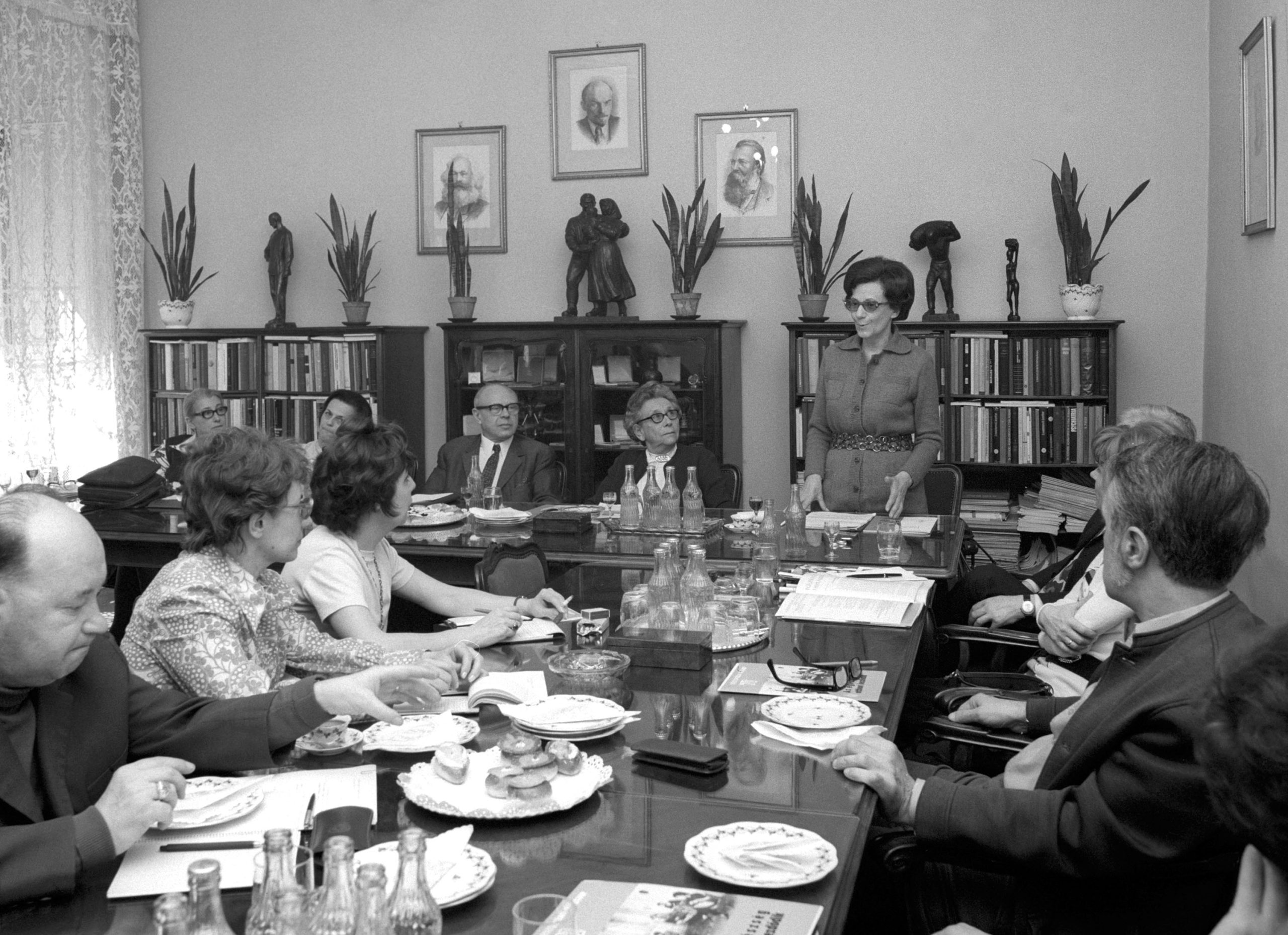
Zsuzsa Ortutay, a member of the National Council of Hungarian Women (MNOT), speaks at a press conference held at the Ministry of Health on the occasion of the 25th anniversary of the WHO (World Health Organization) and World Health Day, entitled “Health begins in the family.” Next to Ortutay sits pediatrician Emmi Pikler. Budapest, April 6, 1973. Photo by Gyula Kovács. Credit: MTVA / MTI
Intellectual influences
Similarly to others in this period, Zsuzsa Ortutay’s intellectual influences were closely connected to the reform and resistance movements of the interwar period. The artist Olga Szentpál and her husband, the art historian Máriusz Rabinovszky, both made a strong impression on Ortutay. It was Szentpál, who convinced (and financially aided) her to turn her passion into a profession.
The Ortutays were active in the Szeged Youth Art College and the János Vajda Society: Gyula as an emerging folklorist, Zsuzsa as a dancer and performer. The couple also developed a close friendship with Miklós Radnóti, a renowned Jewish poet murdered in the Holocaust, and his wife, Fanni Gyarmati, a teacher and writer. These intellectual influences – ranging from art history, folklore, classical studies, and leftist, anti-war, and anti-fascist circles – encompassed both escapism and resistance. Many members of the interwar intellectual opposition turned to antiquity as a source of inspiration, which enabled them to articulate meaningful forms of resistance while simultaneously distancing themselves from the contemporary rise of fascism. Zsuzsa Ortutay drew on these intellectual traditions and learned to adapt to shifting political circumstances.
International engagement and networks
In the immediate post-war period, Zsuzsa Ortutay played a decisive role in foreign relations of the women’s council. She regularly participated in protocol events (such as opening and award ceremonies or receptions) at various local and international venues. She was the member of the MNOT delegation at the congresses of the Women’s International Democratic Federation (WIDF) in Budapest and Helsinki. In 1970, Ortutay traveled to the Soviet Union as part of the MNOT delegation to participate in the Lenin Symposium in Moscow. Ortutay and Júlia Turgonyi – a social scientist and member of the MNOT – met the Soviet cosmonaut Valentina Tereshkova, who regularly appeared at women’s policy events. While the MNOT supported her international connections through various congresses and meetings, Zsuzsa Ortutay also built international relationships independently. As vice-president of the Fédération Internationale pour l’Éducation des Parents, an international NGO founded in 1964 in Sèvres, she maintained professional ties primarily with French colleagues, including the physician and psychoanalyst André Berge. Moreover, Ortutay was a member of the International Committee formed on the occasion of the UN International Year of Children in 1979, and raised awareness of child poverty and malnutrition.
Research and activism with an emphasis on feminist knowledge
Zsuzsa Ortutay’s work addressed topics related to gender relations, women’s double burden, invisible labour, elderly care and men’s participation in family life. She gained knowledge of the everyday realities and difficulties of Hungarian women through her extensive network of members of women’s movements, social scientists and ethnographers. In her publications, Ortutay addressed the housing shortage, the lack of household appliances, the lack of sufficient number of childcare institutions (nurseries, kindergartens) specifically affecting industrial workers, and the various factors that hindered women’s education and professional advancement.
In relation to the population policy programs of the late 1960s, Ortutay framed childbearing as simultaneously a public and a private matter, while critically examining children’s rights in the context of pro-natalist policy. Her thinking was aligned with both officially-supported pro-natalism and the socialist ideal of the heterosexual nuclear family, while incorporating less commonly emphasized aspects, such as modern fatherhood. From Ortutay’s perspective, fathers were expected to participate actively in both household labour and childrearing, reflecting the broader socialist principle that a modern society should be grounded in gender equality. Although the official discourse primarily held mothers responsible for reproduction and childrearing, Ortutay consistently incorporated fathers’ roles in education and family life into her MNOT speeches, reports and publications, opening new directions in the debate on population.
For Ortutay, public education and the role of primary schools was inseparable from women’s equality. She emphasized the need to nurture gender equality from early childhood. In her opinion, children in primary schools should be taught to manage the household and a family – boys and girls equally. In 1976, she co-authored a methodological guide with the pedagogue Erzsébet Gál on “family life education” – the socialist equivalent of sex education. Their book, Education for Family Life in the Home and at School, was designed for both professionals and parents, emphasizing the cooperation of families and teachers. In this manual, Ortutay and Gál addressed the problems of the traditional family structure, and envisioned a new, democratic family model grounded in parental equity. In their view, the ideal socialist society had yet to be realized, but its transformation was already proceeding, signalled by the decline of authoritarian childrearing practices. Ortutay and Gál framed parenthood as a consciously learnable skill, marking a shift from intuitive childrearing to the professionalization of socialist childrearing and pedagogy.
Legacy and impact
Despite her multidisciplinary professional path, Zsuzsa Ortutay’s legacy was overshadowed by both her husband’s political and intellectual work, and other Women’s Council members’ activity. Through her professional work, Ortutay influenced several fields, including pedagogy, parent-teacher relations, women’s emancipation, and health care. Yet relatively few publications address her life and contributions, and much of her multifaceted legacy remains to be explored.
DOI: 10.56514/bd.wef.0008
Fanni Svégel
Selected Works
Gál, Erzsébet, and Zsuzsa Ortutay. Családi életre nevelés a szülői házban és az iskolában. [Education for Family Life in the Parental Home and at School] Budapest: Hazafias Népfront–Kossuth Könyvkiadó, 1976.
Ortutay, Zsuzsa. “Autobiography.” July 17, 1978. Institute of Political History Archives, Budapest. PIL 908.1. őe.
Ortutay, Zsuzsa. “Népesedés és család.” [Population and the Family] Társadalmi Szemle 21, no. 10 (1966): 73–83.
Ortutay, Zsuzsa. “A nő hivatása és a leányok munkába állása.” [Woman’s Vocation and Girls’ Entry into Employment] Társadalmi Szemle 20, no. 10 (1965): 38–43.
Ortutay, Zsuzsa. “Család és iskola együttműködése a nevelésben: A szülői munkaközösségek feladataihoz.” [Cooperation between Family and School in Education: On the Tasks of Parent–Teacher Associations] Társadalmi Szemle 16, no. 6 (1961): 78–85.
Bibliography
Svégel, Fanni. “The Personal Is Political? Ortutay Zsuzsa és a Magyar Nők Országos Tanácsa.” [The Personal Is Political? Zsuzsa Ortutay and the National Council of Hungarian Women] Sic Itur ad Astra 80 (2023): 211–230.
Varsa, Eszter. “‘Respect Girls as Future Mothers’: Sex Education as Family Life Education in State Socialist Hungary, 1950s–1980s.” In Children by Choice? Changing Values, Reproduction, and Family Planning in the 20th Century, edited by Ann-Katrin Gembries, Theresia Theuke, and Isabel Heinemann, 77–98. Oldenbourg: De Gruyter, 2018.